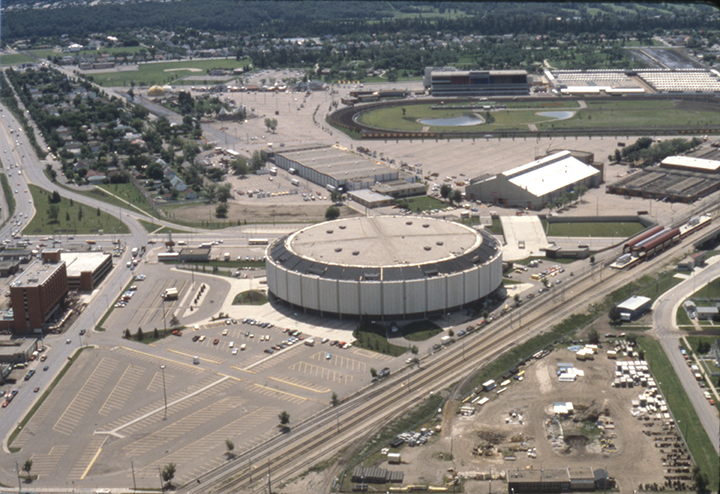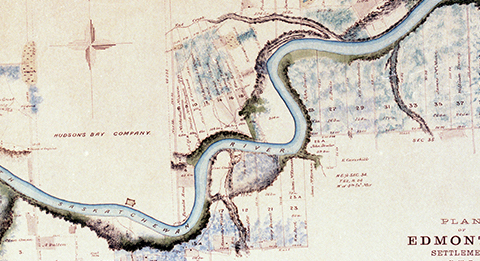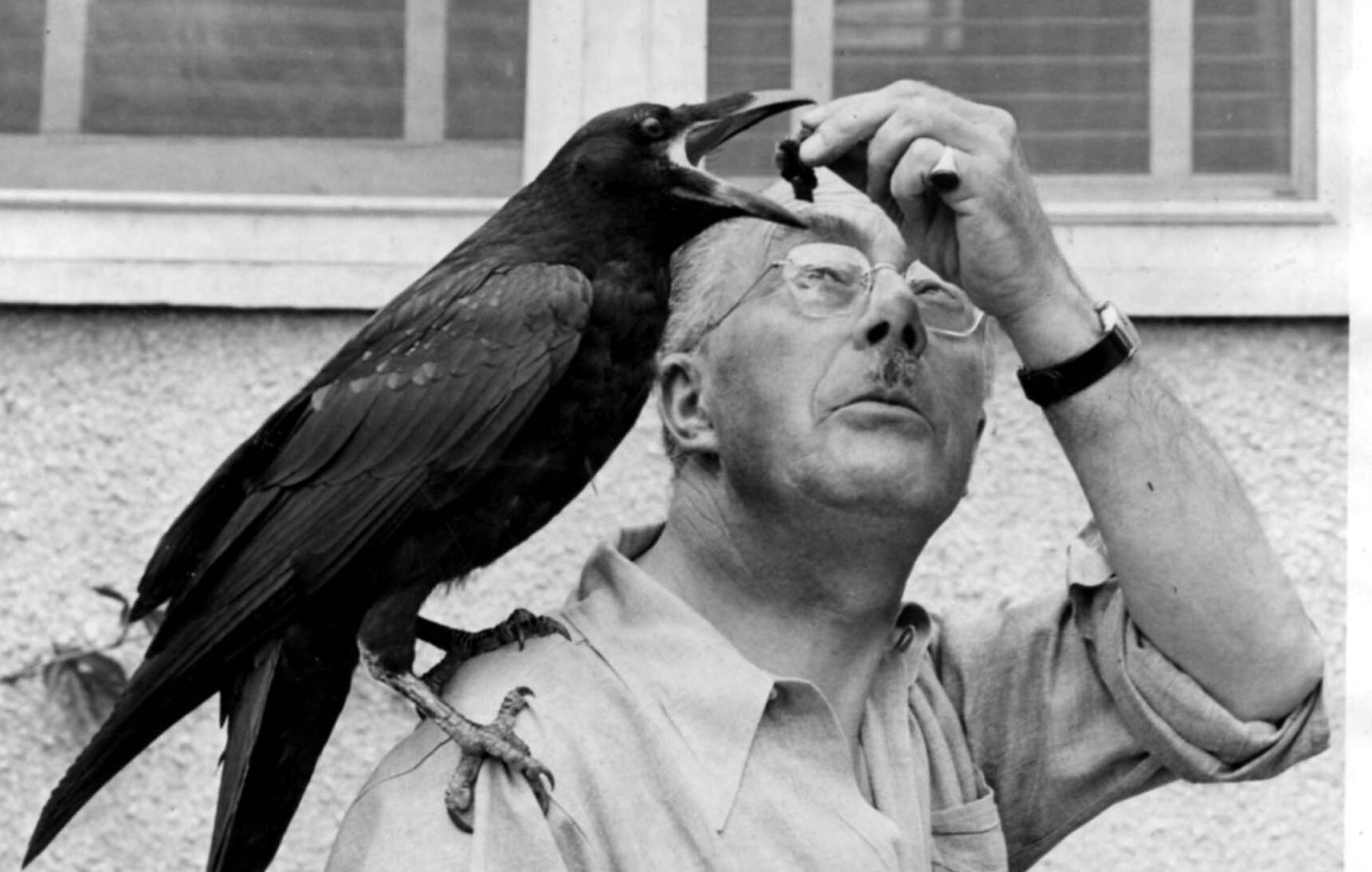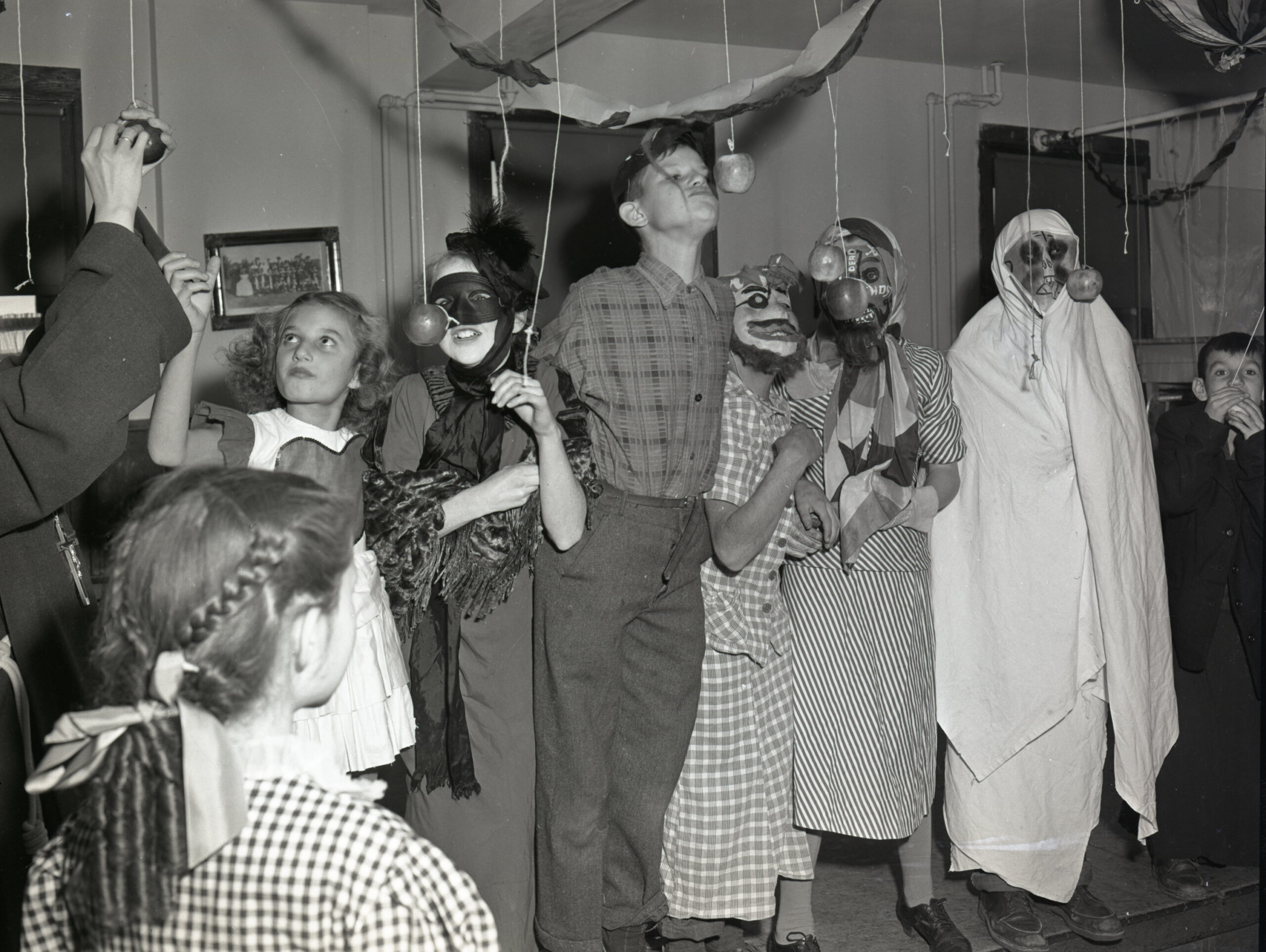
It is October 31st, 1941. The crisp feeling of autumn air, leaves crackling fire-like across the ground, and the sound of children laughing suffuse Halloween evening. The sun hangs precariously on the horizon as the darkness of night expands… but the ghosts and goblins wandering Edmonton’s streets are undeterred. The trick-or-treaters run from one house to another, homemade paper and cloth masks bobbing up and down as they ascend creaky wooden steps towards the next illuminated doorway, and once there they shout in unison the all too familiar demand: “Halloween apples!”
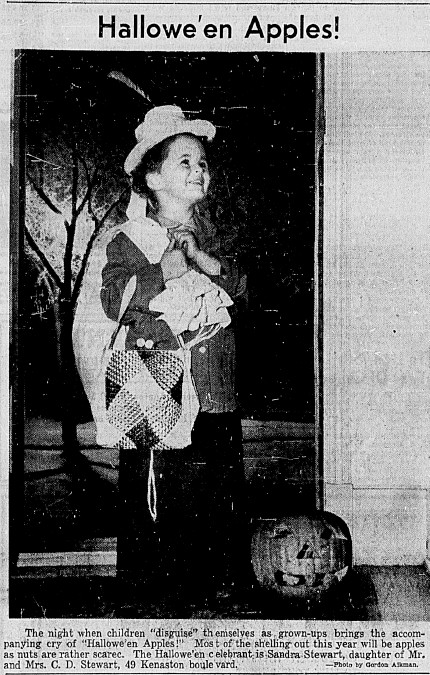
For generations of Edmontonians, this phrase stirs childhood memories. For others, it is a puzzling, unheard-of relic.[1] From roughly the 1920s until the 1980s, “Halloween apples!” competed for popularity with the playfully extortionate expression “Trick or Treat.” Contrary to popular belief, the first recorded use of “Trick or Treat” was not in Alberta, but in Ontario. “Halloween apples,” however, was a distinctly Prairie phrase.[2] Tracing the phrase’s emergence, popularity, and decline can illuminate numerous aspects of Edmonton’s social history. Why did trick-or-treaters want apples so badly? Why did the phrase become so popular among them? Why its decline? To answer these questions, we must delve into Edmonton’s social history, the history of consumer culture, and the powerful effects of urban legends. The one-time ubiquity of the phrase and its slow decline can be attributed to one of the most infamous Halloween urban legends: the apple bearing a razor blade. Sensing the city in relation to “Halloween Apples” – the sound of the phrase and the taste of apples themselves – reveals the change in character of this much-beloved holiday, and how people navigate risk on a night where they expect safe scares.
A Seasonal Treat
Many aspects of Halloween – ghosts, witches, jack o’ lanterns, and black cats – were already popular by the time trick or treating became an annual practice in Edmonton. Irish and Scottish immigrants brought with them many Halloween night traditions which then spread throughout North America.[3] Given the seasonality of apples (if not eaten in fall, they were destined to go bad in winter), the fruit was involved in many Halloween practices like bobbing for apples, reading one’s fortune in an apple peel, and making candied apples.[4] Much like the imagery of ghosts, witches, orange-and-black décor, and the practice of trick or treating itself, the phrase “Halloween Apples!” was imported into Treaty 6 territory. It started in Manitoba during the 1910s, and its earliest recorded use in Edmonton seems to date from 1929. “Halloween apples” quickly became a standard expression.[5] A 1941 Journal report describes Halloween night in Edmonton as follows:
The ‘eeriest’ hours of the year, Friday evening will see Hallowe’en ghosts and goblins, witches and elves, fairies and gnomes, and a host of other Tom Thumb-sized creatures garbed in spine-chilling costumes and wearing spooky masks, noisily shouting and running at will through Edmonton.
It is the night of the year for many youngsters… It gives them a chance to collect apples, candy, peanuts and popcorn from each house in the neighborhood without having to explain why. They just have to shout: ‘Hallowe’en Apples!”[6]
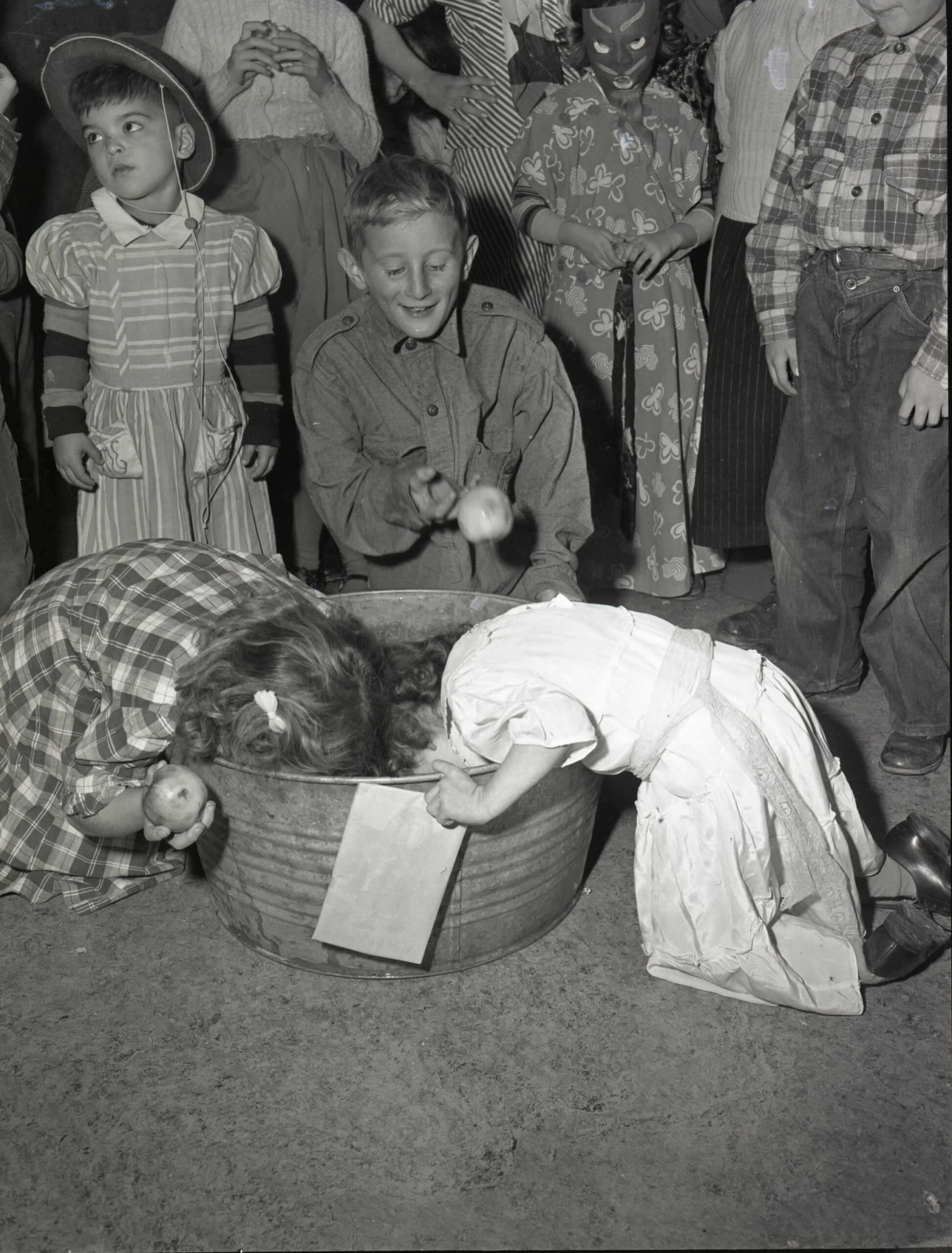
As this description suggests, the phrase became virtually ubiquitous with the observance of Halloween in Edmonton. While households might give out popcorn balls, nuts, and candy, Edmonton’s children saw apples as the prized treat of the evening. “Halloween Apples” were widely advertised throughout the mid-century, and stores sold them by the box in the weeks leading up to October 31st.[7] With the growing baby boom population, hundreds of apple-hungry trick-or-treaters appeared at Edmontonians’ doors on any given Halloween night.[8] As one Edmonton observer noted, apples “are the status symbol of the miniature witches and goblins… the total value of the evening’s haul is in direct proportion to the number of apples received.”[9] Edmonton’s community leagues also included games such as “hanging apples” as part of their October 31st festivities.[10] Often made into other treats by parents over subsequent days or voraciously eaten by the children themselves, the taste of apples was a staple of the Halloween season for generations of Edmontonian children.
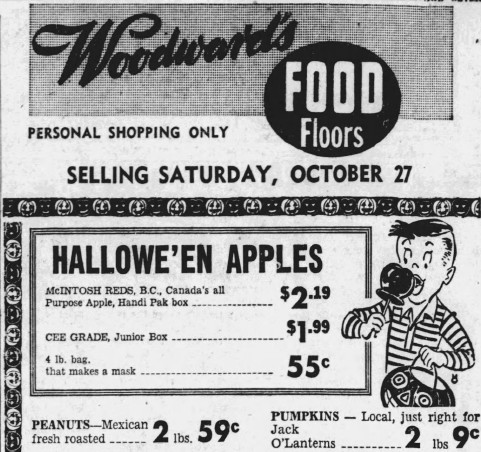
Razor blades in apples were real, but rare
By the late 1960s, though, Halloween apples started developing a bad reputation. Reports of razor blades, pins, and nails hidden in apples led to a veritable North American panic, with reports of such incidents spreading across the continent. A handful of actual such instances did occur in Edmonton, and thankfully only one child seems to have been hurt when she cut her finger on a razor blade while taking an apple out of her bag of treats.[11] Without minimizing these appalling incidents, actual cases of tampered apples were greatly exaggerated and, over time, became an urban legend. Sociology and criminal justice professor Joel Best has conducted research on “Halloween sadism” in the United States as far back as the 1950s and found no reports of a child dying or being severely injured due to eating tampered candy from trick or treating.[12]
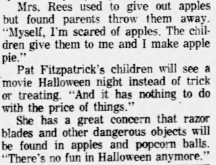
However exaggerated the risk may have been, the fear of apples bearing a razor blade had real historical effects. By the end of the 1970s, many Edmonton parents were forbidding their children from accepting apples while trick or treating. Instead, Halloween became firmly centered on mass-produced packaged candy, in large part because of the perceived safety that it afforded. Unpackaged treats were increasingly forbidden by Edmonton’s parents, and their disposal became part of the post-trick-or-treating ritual. As one reporter put it in 1978, “Apples have pretty well vanished from the annual Halloween scene.”[13] Not just apples themselves, yelling the phrase “Halloween apples!” door-to-door also became increasingly unpopular, given the images it conjured amidst the razor blade panic.
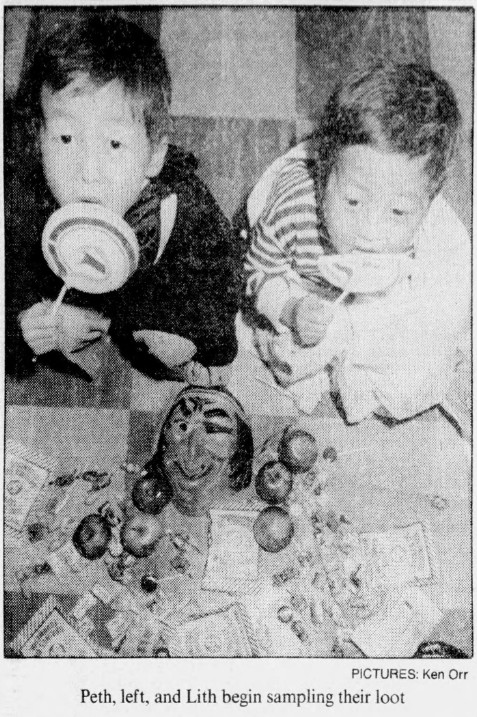
The phrase “Halloween apples” slowly declined rather than swiftly disappearing from the soundscape of Edmonton’s Halloween nights, though. In 1979, the Edmonton Journal ran a news story about two recently resettled Cambodian refugees, Lith and Peth, who had gone on their first night trick-or-treating. Dorothy Gee, a Chinese-Canadian who accompanied Lith and Peth and was helping to teach them English, had a decision to make between teaching them “Trick or Treat” or “Halloween Apples” – the latter was no longer a default phrase. Gee made the choice to teach them “Halloween Apples,” and some households responded in kind by giving out apples.[14] As this suggests, the taste of apples did not simply vanish from Halloween night either, and “Halloween apples” was still a phrase occasionally used. But this was at the twilight of the phrase’s popularity: by the 1980s, the wane of the phrase was noticeable, and had fallen essentially into disuse by the twenty-first century.
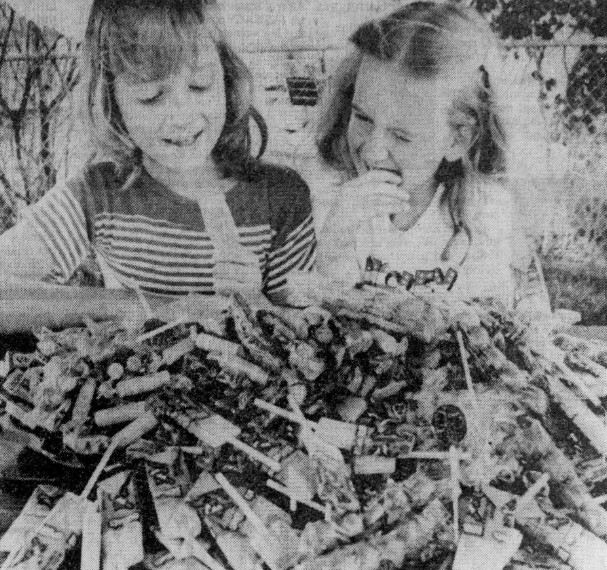
By century’s end, the place of apples in Halloween’s observance had changed dramatically. The decline of the phrase “Halloween Apples” was inseparable from the decline of Halloween apples themselves. The seasonal anticipation of eating apples was largely replaced by the seasonal anticipation of eating packaged candy. Rather than throwing away apple cores, children now mainly throw away plastic wrappers. Indeed, plastic waste is now central to how Halloween is observed.[15] But just as many aspects of Halloween’s observance have changed over time, so too can the centrality of plastic waste as a feature of Halloween night. Part of Halloween’s appeal is that it gives us a chance to confront our fears: perhaps confronting our lingering fear of the razor blade-bearing apple is one way to start that change.
Footnotes
[1] This has long been an amusing topic of journalistic and popular discussion – Don MacGillivray, “A child’s game by any other name,” Edmonton Journal [hereafter Journal], Aug. 20, 1990, C2; “On the Edge,” Journal, Oct. 27, 2001, F1; Andrew Kurjata, “’Halloween apples!’ Meet the Canadian Prairies’ sing-song alternative to trick or treat,” CBC News, Oct. 31, 2020, https://www.cbc.ca/news/canada/british-columbia/halloween-apples-1.5784783; u/seaweaver, “Halloween Apples?,” r/Calgary, Reddit, Oct. 29, 2023, https://www.reddit.com/r/Calgary/comments/17jia0n/halloween_apples/
[2] It was even defined as a regionally specific interjection in the Canadian Oxford Dictionary. Katherine Barber, ed., The Canadian Oxford Dictionary 2nd ed. (Oxford University Press, 2004). Etymologist Barry Popik has found the earliest instances of the phrase “Trick or Treat” in Ontario – it does appear in Alberta as early as 1922 – “‘Trick or Treat’ (‘Trick or Treat for UNICEF’),” accessed Sept. 20, 2026, https://barrypopik.com/blog/trick_or_treat “Hallowe’en and Snow is Unusual Combination here,” The Sault Star, Nov. 1, 1917, 2; “Treat or trick/trick or treat,” Owen Sound Sun, Nov. 2, 1917, 2.
[3] Nicholas Rogers, Halloween: From Pagan Ritual to Party Night (Oxford University Press, 2002), 27—53.
[4] Rogers, Halloween, 27—48.
[5] See, for example, Phyllis Clark, “How Jolly,” The Winnipeg Tribune, Oct. 28, 1916, 54; the phrase seems to have been partly solidified as a common way to ask for apples alongside Trick or Treat because of a public outcry from Winnipeg’s women. As nuts and other candy were increasingly being given out during the 1930s (a disappointment to Winnipeg children), multiple women wrote columns demanding apples be recognized as the treat to give out on October 31st. See June Horne, “Gives Apples on Hallowe’en, It’s Patriotic,” The Winnipeg Free Press, Oct. 27, 1939, 11; Katharine Middleton, “Apples – Fruit of History – Are Linked With Hallowe’en,” The Winnipeg Tribune, Oct. 30, 1939, 10. The earliest recorded use I have found where the phrase is specifically used for trick-or-treating is the followingarticle: “Hallowe’en’ Apples!,” Journal, Oct. 28, 1929, 4.
[6] “Ghosts, Witches Out on Friday,” Journal, Oct. 30, 1941, 14.
[7] “Woodward’s Food Buys,” Journal, Oct. 28, 1949, 7; “Co-op Shopping Centres – Produce Specials,” Journal, Oct. 26, 1966, 31.
[8] Edmonton’s population grew from 90,149 in 1939 to 137,469 in 1949; reflecting the influence of the baby boom, by 1959 the population had nearly doubled to 260,733 (Municipal Censuses, accessed Sept. 15, 2026, https://www.edmonton.ca/city_government/facts-figures).
[9] Barbara Lacroix, “Counter Points,” Journal, Oct. 27, 1965, 23; see also Art Evans, “Last night about 9,” Journal, Nov. 1, 1978, A20.
[10] Edwina Proudfoot, “Hallowe’en,” Journal, Nov. 7, 1969, 12.
[11] “More Razor Blades Found in Apples,” Journal, Nov. 3, 1967, 43; for the next several years, these reports became a regular part of post-Halloween news – “Halloween horrors still being found,” Journal, Nov. 2, 1968, 15; “Halloween treats can be dangerous,” Journal, Oct. 31, 1969, 1.
[12] Joel Best and Gerald T. Horiuchi, “The Razor Blade in the Apple: The Social Construction of Urban Legends” Social Problems 32, no. 5 (June, 1985), 488—499. Best has continuously updated this research since, and is publicly available at “Halloween Sadism: The Evidence,” Joel Best, accessed Oct. 9, 2026, https://www.joelbest.net/halloween-sadism See also Sylvia Grider, “The Razor Blades in the Apples Syndrome” in Perspectives on Contemporary Legend: Proceedings of the Conference on Contemporary Legend, Sheffield, July 1982 ed. Paul Smith (CECTAL, 1984), 128—140.
[13] Art Evans, “Last night about 9,” Journal, Nov. 1, 1978, A20; see also Brian Tucker, “Candy prices may lighten trick-or-treaters’ bags,” Journal, Oct. 26, 1971, 1, where multiple people discuss not giving out apples and parents throwing apples away. Edmontonian-born columnist Alex Mair writes about getting apples trick-or-treating as a thing of the past in “I’ve been looking,” Journal, Oct. 31, 1980, E4.
[14] Debbie Weismiller, “First Halloween puzzling, but fun,” Journal, Nov. 1, 1979, B1.
[15] About which – along with some ideas about changes one can make on the holiday – see Tanyasingh Mokashi, “Simple swaps for a more fun and sustainable Halloween,” The Green Review – University of New Brunswick, posted Oct. 24, 2025, https://blogs.unb.ca/thegreenreview/2025/10/sustainable-halloween.php