Have you ever watched a bird and wondered why and how it migrates? We may take the seasonal movements of birds for granted, watching flocks gather in fall or listening to them return in spring. What invisible signal tells a bird that the seasons have changed, and which direction to fly? This ‘Riddle of Migration’ was once one of the great unanswered questions of natural science. Remarkably, part of the search for an answer took place right here in Edmonton.
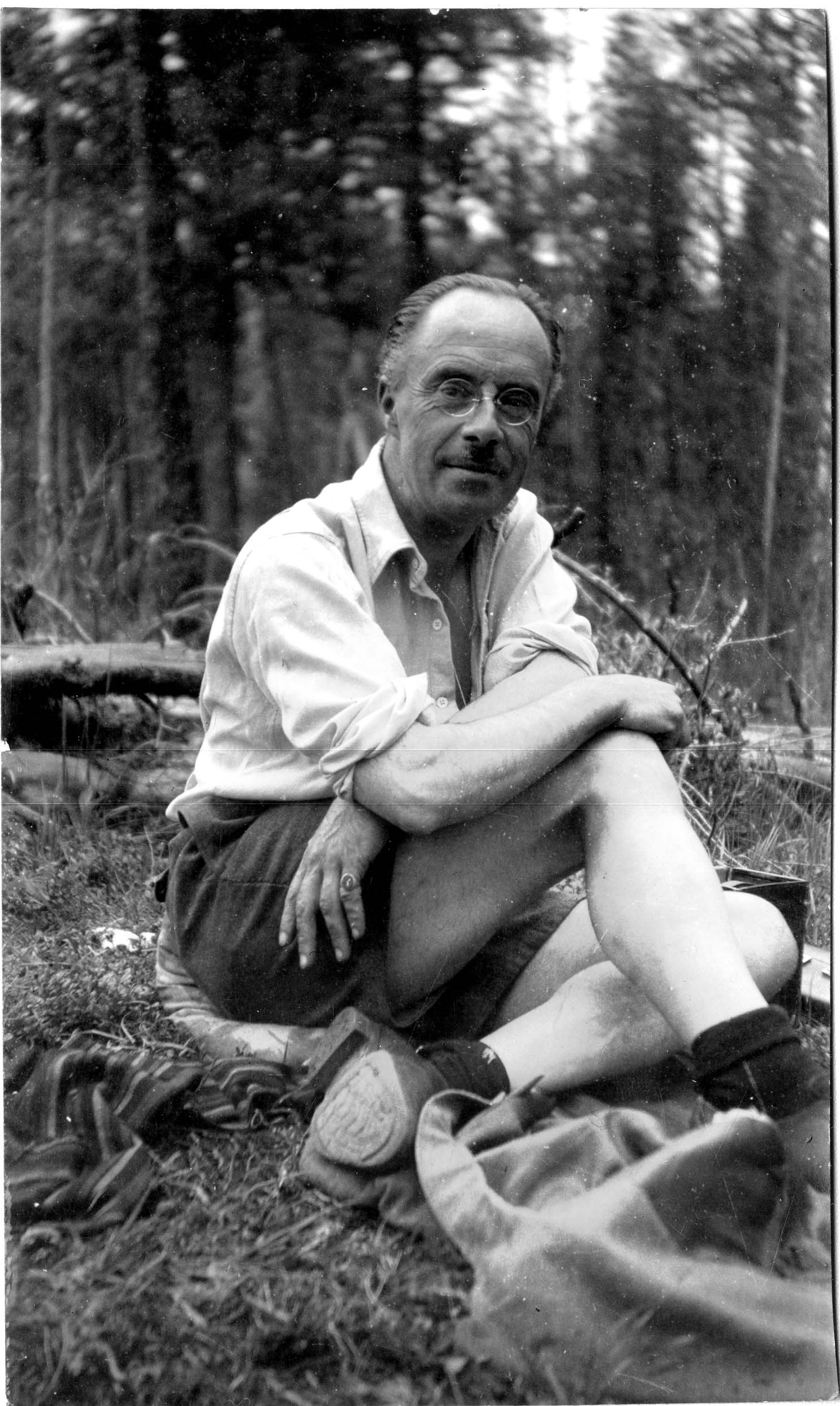
In 1920, Dr. William Rowan moved to Edmonton, with his family, to help develop the Zoology department at the University of Alberta.[1] They settled in Garneau, “which was the heart of the small university community.”[2] Rowan quickly became fascinated by Alberta’s wildlife and spent increasing amounts of time out in the field, which captivated his scientific and artistic imagination. His enthusiasm for fieldwork and birds was at odds with the University’s president, Henry Marshall Tory, and thought “if becoming full professor meant sacrificing his interests to conform to Tory’s narrow view of scientific research, it was simply not worth it.”[3] Instead, Rowan chose to continue his research, sometimes even in his own backyard.
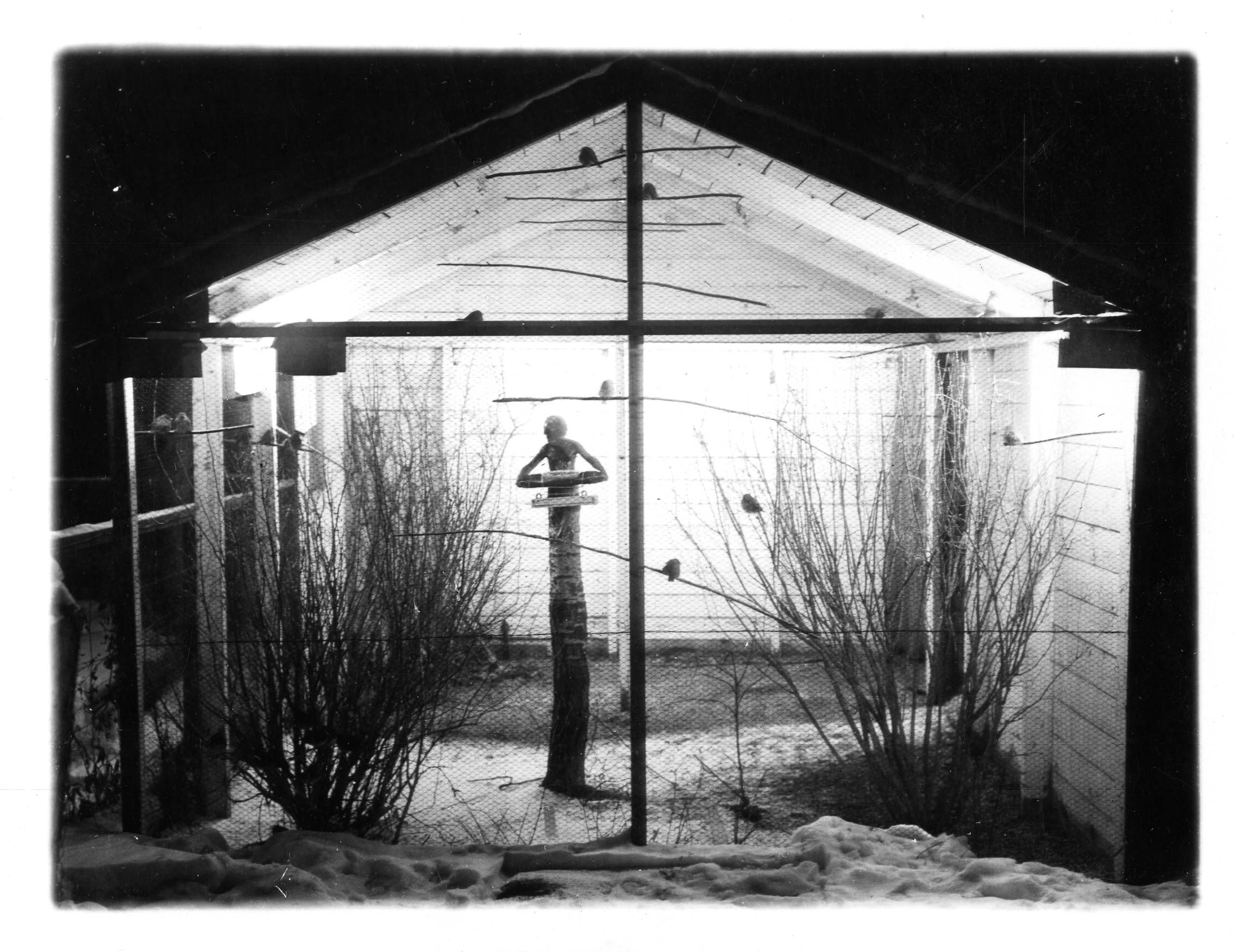
In 1924, Rowan began experimenting with dark-eyed juncos in a double aviary he constructed in his backyard. By exposing one group of birds to artificially-extended daylight during Edmonton’s winter, he demonstrated that light could influence their reproductive cycle, opening a “new field in avian biology that today is known as photo-periodism in birds.”[4] Rowan wanted to investigate whether light could also help explain migration. The juncos were too small and difficult to track after release and couldn’t be legally shot for collection, though. Instead, he turned to a larger, more conspicuous Albertan bird: the Common Crow.[5]
The Common Crow
Before continuing, it is worth pausing to consider the bird itself. The Common Crow is an “entirely glossy jet black with some purplish iridescence on upperparts;” most easily distinguished from the raven by its smaller size, voice, and tendency to migrate south for winter.[6] Before migrating, crows gather together in large flocks, or a rookery; something which Rowan hoped to exploit.
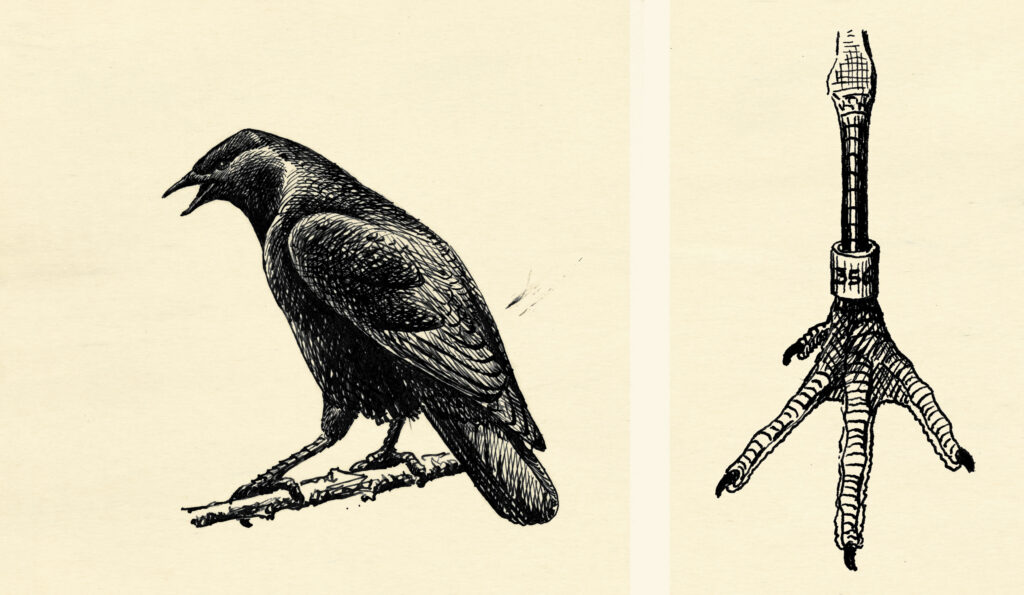
During the 1920s-1930s, the crow occupied a rather different place in the Albertan consciousness. Farmers regarded them as marauding pests and the Albertan government even offered prizes “to destroy crows, magpies, and gophers.”[7] Alberta, Saskatchewan, and Manitoba all spent considerable sums reducing crow populations, and they could be legally killed while many other migratory birds were protected. As Rowan explained:
It became apparent that we would have to find better guinea pigs of the airways, birds universally familiar and large enough to be followed on release, and unprotected by law. …The obvious answer was the crow, omnivorous and easy to keep, avian vermin that might be shot by anyone at any time.[8]
Rowan’s Crow Migration Experiment
Rowan wanted to investigate what he called the “mechanism of migration,” particularly his theory “that light plays a major part in determining when birds migrate and whether they travel north or south.”[9] Could he artificially make crows’ bodies respond as though spring had arrived, then release them in winter to see if they flew north instead of south?
The practical problem was catching enough crows. Rowan hoped to obtain around 400 in 1929, but the birds proved difficult to trap alive. Beginning in August, Rowan and his assistants, Robert Lister and Tom Randall, travelled to Beaverhills Lake and its surrounding farmland. They used bait, traps, and nets to catch the crows. However, the crows soon learned to avoid traps where other birds had been caught.[10] The gathered crows were regularly transported back to Edmonton.[11] Even though most of the crows were caught elsewhere, there were still attempts in Edmonton. There was a particularly unsuccessful attempt in Bonnie Doon. Rowan and roughly twenty others tried to drive crows into large fish nets strung from tall poles around a grove of poplars. They only caught three crows, out of possibly hundreds.[12]
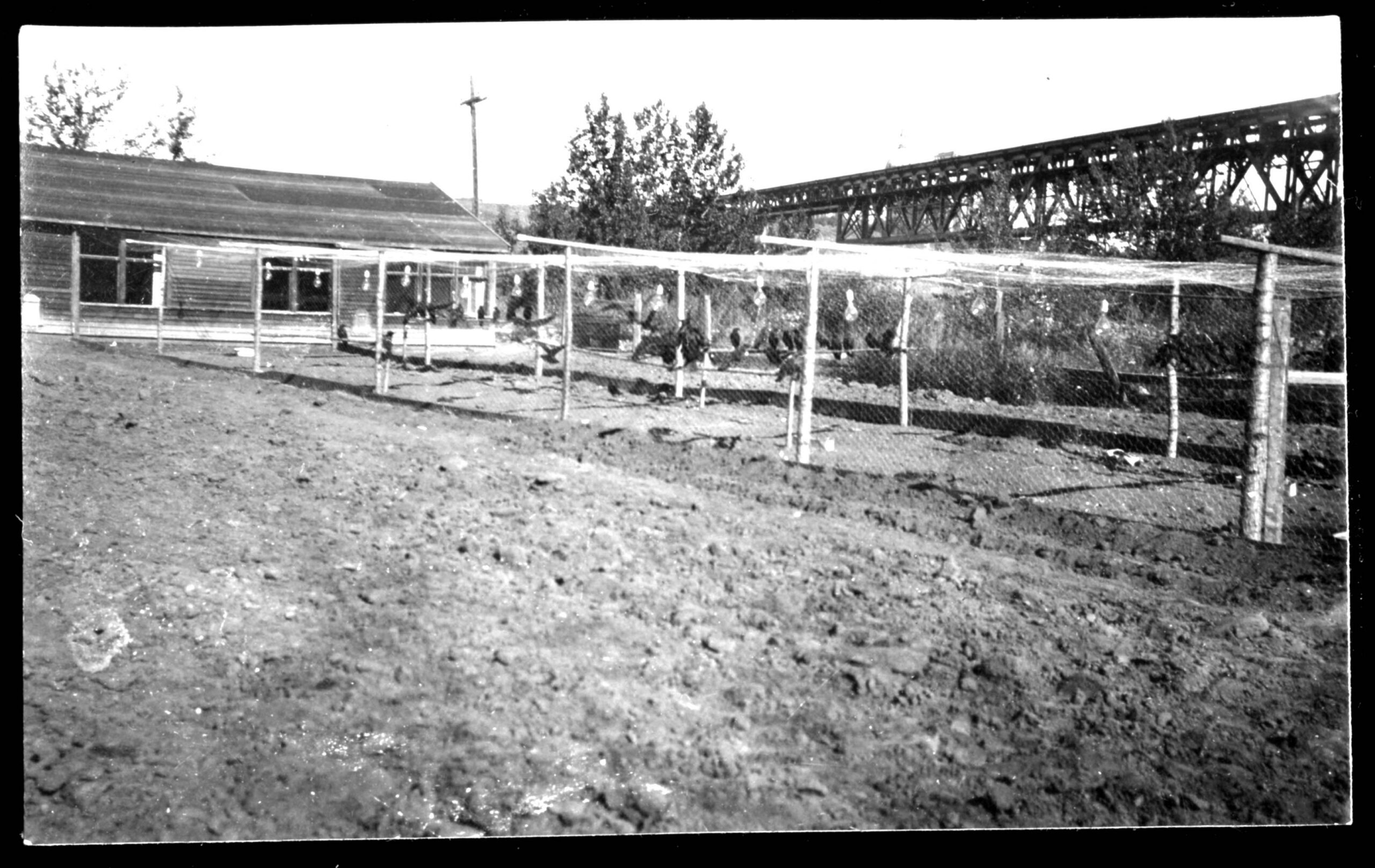
The experiment’s location was almost as conspicuous as the birds themselves. The large flight cages stood on the low southern flats just west of the High Level Bridge, in what is now part of West Kinsmen Park. As Lister recalls, the site showcased Rowan’s “flair for the dramatic”:
In those days the street cars as well as trains crossed over on the top deck of the bridge while other traffic and pedestrians used the lower deck still very high above the aviary. There was much comment from the time the first crows arrived and when the lighting started there were few people in the city who were not aware of Professor Rowan and his birds.[13]
It must have been quite the sight and stench. The crows’ food consisted mainly “of rotten eggs, dogs and cats from the city pound, an occasional horse, green stuff of various sorts, grain and chicken mash, stale bread and buttermilk.”[14]
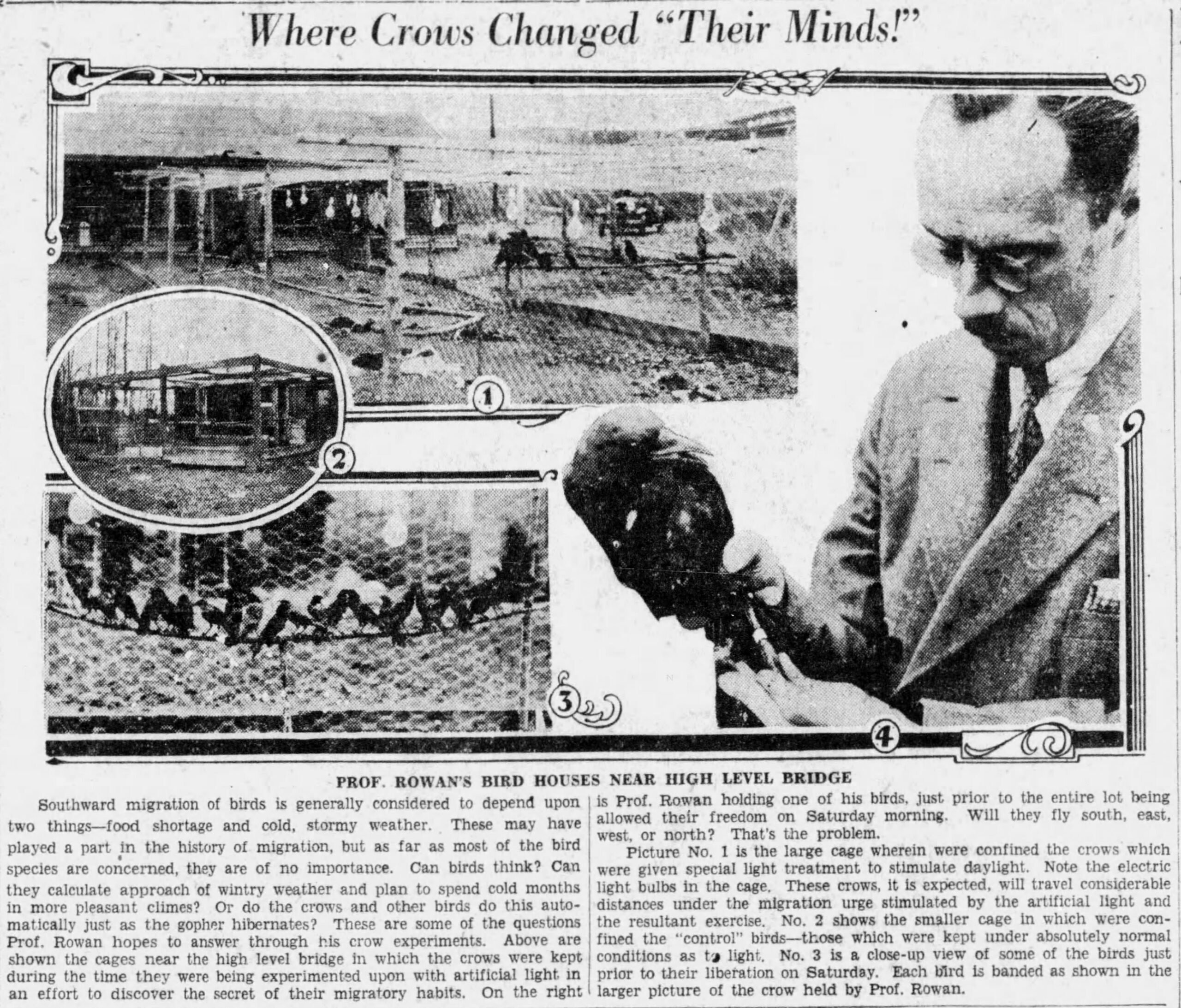
Similar to his earlier junco experiments, just at a much larger scale, Rowan divided the captured crows into two groups. “Controls” were kept under ordinary day conditions, and “experimentals” were exposed to periods of artificial light after sunset intended to mimic the longer spring days. Housed in separate cages, the experimental crows received additional lighting from September 28th to November 9th.[15] Rowan periodically examined birds from both groups, studying their reproductive organs and condition. On November 9th, Rowan and his assistants opened the cages and released the birds into Edmonton’s River Valley. They were all banded, allowing their movements to be tracked if they were later recovered. There was even considerable effort in getting the public to participate in the coming “crow-shoot.”[16]
The Journal described how they “threw open the doors and invited the prisoners to wander forth into the great outdoors.” The experimental birds set off first and “every bird followed the valley northward—not a crow turned toward the south,” while the controls reportedly lingered around the cages and nearby trees.[17] At first, this seemed to be precisely the result Rowan had hoped to see; birds that should have migrated south were heading north. However, Rowan “regretted that birds released in Edmonton, even if they did fly north, must travel over miles of wooded and unsettled country where the chances of them being seen were most remote.”[18]
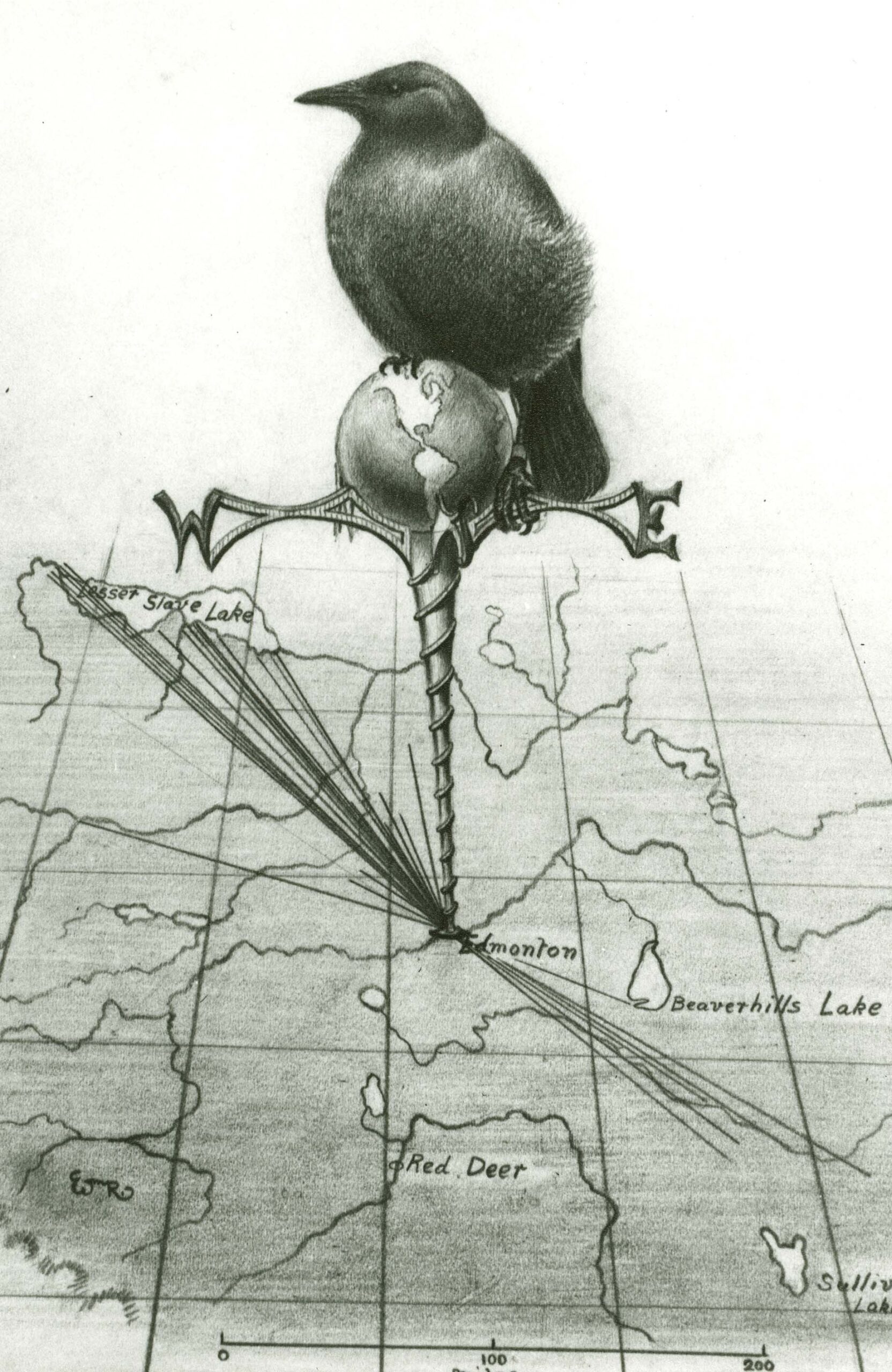
Image Alt Text: A drawing of a crow sitting on top of a marker over a map below centred on Edmonton with lines coming out from the city, most to the northwest towards Lesser Slave Lake and the other towards the southeast. The lines follow the migration paths of crows from Rowan’s 1929 experiments.
While Rowan’s 1929 crow experiments never provided a definite answer, his earlier work had opened a new field of study. As Lister later wrote, “There was no question. The sexual cycle was influenced by the light.”[19] This pioneering work in Rowan’s Garneau backyard and River Valley aviaries was repeated around the world, and research into photoperiodism continued long after his death in 1957. Rowan’s persistence and passion made him one of the University’s most recognizable characters of the time.[20] His scientific intensity and flair for spectacle seem to have been inseparable.
Crows and Us
But what did that pursuit of knowledge cost? Hundreds of birds were captured and confined. Some died or were sacrificed, in the name of science, so they could be examined; others were deliberately released with the hope that members of the public would shoot them and return their remains. Rowan argued that “it is necessary to kill at least ten of the specie[s] in order to get a complete record.”[21] It was a different scientific culture, one in which the individual animal lives could be weighed against the knowledge gained from studying them. Today, we can admire Rowan’s ambition while feeling uncomfortable with his methods.
Perhaps this contradiction is worth considering alongside our perception of crows. In Rowan’s time, crows were described as pests and vermin, killed for bounties. By the 1960s, however, Lister was challenging this view:
We are too prone to endow birds and other animals with human motives, particularly our failings. The crow is branded as a black rascal, a robber, or by the sentimental as a cruel killer. …Harmful or beneficial are terms that set a dollar value on a species and without either of these there is still a place for the wary crow.[22]
Luckily the crows are still here. Perhaps what has changed most is our understanding of them and our relationship with them.
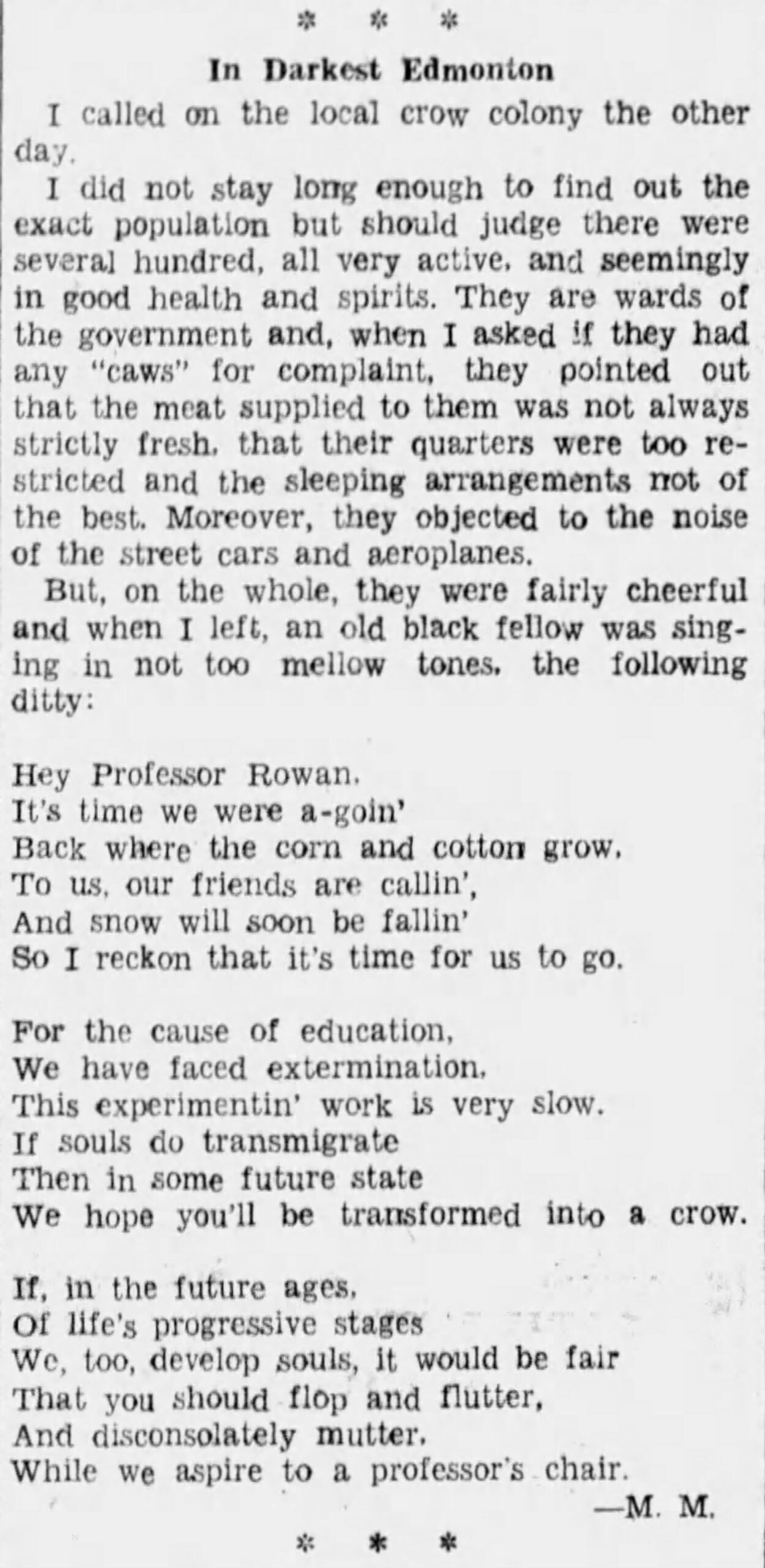
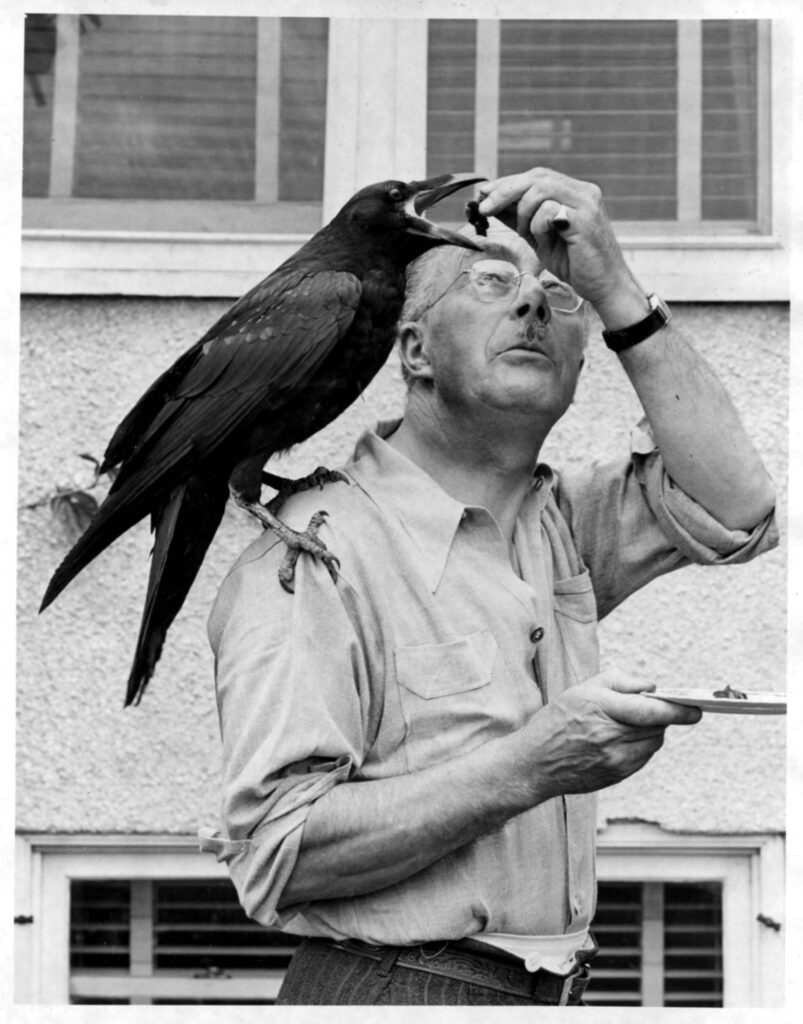
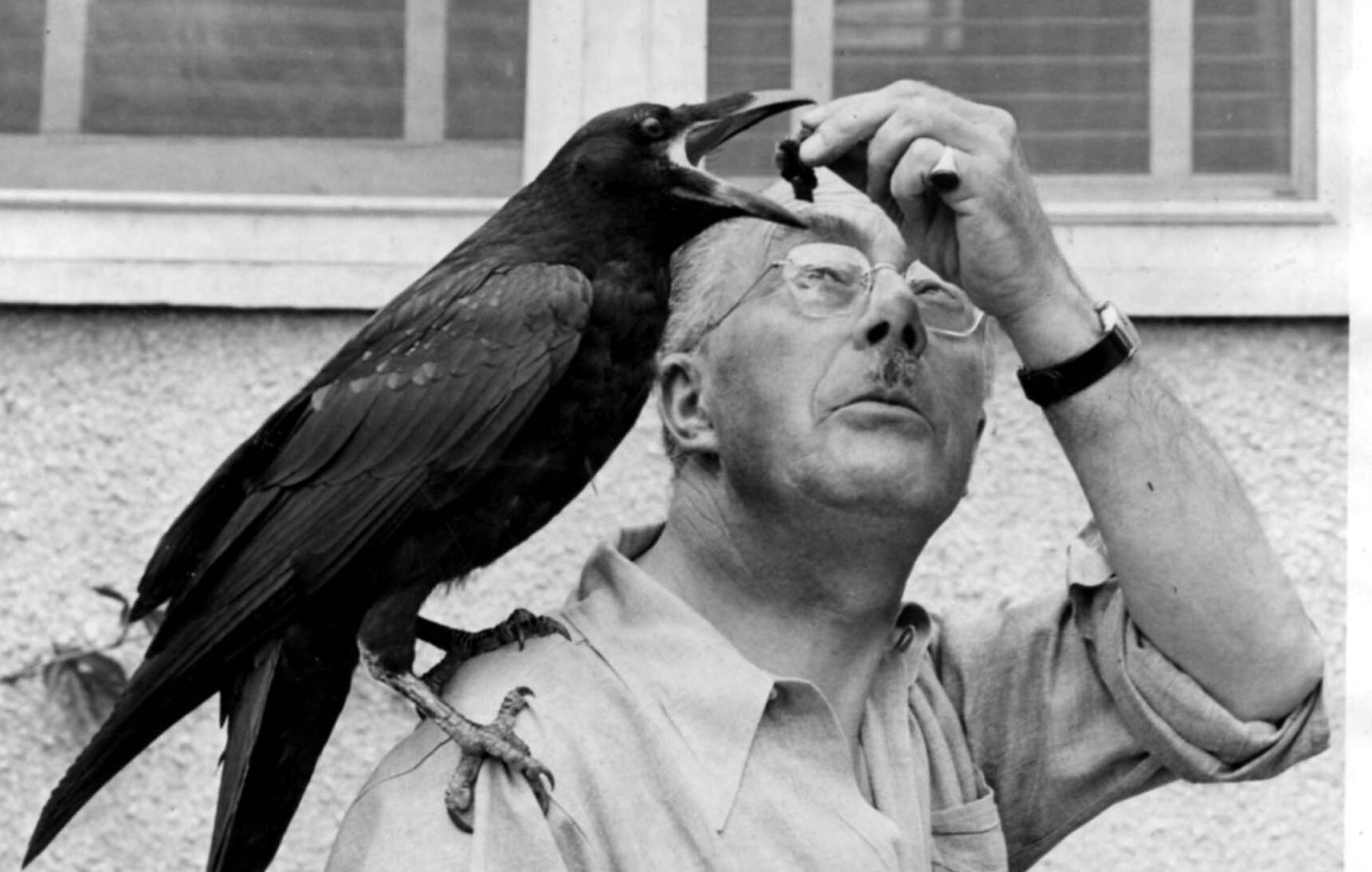
A newspaper clipping of a poem, entitled “In Darkest Edmonton”, by M. M., inspired by Rowan’s crows. Photo: Edmonton Journal, October 13, 1931, p 4. Right: A photograph of Rowan feeding his pet Raven, in the early 1950s, a few years before he passed. Photo: University of Alberta Archives, UAA-1969-016-793-002. Also in Ainley’s book, Restless Energy, p 295.
Seemingly the most fitting response to Rowan’s experiments came not from a scientific paper, but from a rather anonymous poem published in the Journal in 1931. The most wonderful line calls on Dr. Rowan to “be transformed into a crow.” It is ironic, but there is something strangely fitting about it. It seems “crows are a lot like human beings.”[23]
Footnotes
[1] William Rowan was originally from Switzerland and first came to Alberta in 1908, spending three years working as a ranch hand, or ‘cowpuncher.’ After university in England, he returned to Canada in 1919, as a lecturer at the University of Manitoba. The following year, Henry Marshall Tory recruited him to the University of Alberta and develop its Zoology department.
[2] Marianne Gosztonyi Ainley, Restless Energy: A Biography of William Rowan, 1891-1957, (Véhicule Press, 1993), p.101.
[3] Ainley, Restless Energy, p.165. University of president Henry Marshall Tory valued applied science over theoretical and experimental science. His ideas were rigid about scientific research, especially regarding animals, thinking that it should only be done in a laboratory. Tory, like many of the time also looked at the study of birds, as more of a hobby rather than the full fledged science of ornithology, Rowan and his research arguably aided in changing this. For more information, see also the University of Alberta Alumni Association’s History Trails: “The Memorable William Rowan,” https://sites.ualberta.ca/~alumni/history/peoplep-z/93sumrowan.htm.
[4] Robert Lister, The Birds and Birders of Beaverhills Lake, (Edmonton Bird Club, 1979), p.104-105. Rowan’s backyard aviary was divided into two sections: “One half was equipped with electric light, the other had no illumination other than the light of the day.” Beginning in November, after sunset, the lights were on to artificially stimulate one group of birds with artificial spring-like day lengths. The birds exposed only to natural daylight served as the ‘controls,’ while those receiving additional artificial light were the ‘experimentals.’ Rowan periodically examined birds from both groups, and “it soon became evident that light was having a dramatic effect on the genital organs of the birds.” By January, the illuminated birds appeared to be approaching breeding condition, while the ‘controls’ remained largely unchanged.
[5] Robert Lister, The Birds and Birders of Beaverhills Lake, p.106.
[6] W. Ray Salt and A. L. Wilk. The Birds of Alberta. (Government of Alberta, 1972), p. 303. The Common Crow is now commonly called the American Crow and has the scientific latin name, Corvus brachyrhynchos.
[7] “$2,500 In Prizes For Killing Crows: Government Distributes Bounties for Competitions Last Summer,” Edmonton Journal, November 11, 1926, p.18. By 1929, the Edmonton Journal reported that more than 490,000 crows and magpies had been exterminated through five-years of provincial competitions. See: “Thirty Four Resolutions of U.F.A. Receive Replies,” Edmonton Journal, July 20, 1929, p.3.
[8] E. A. Corbett, “The Battle of the Crows and Other Rowan Escapades,” New Trail: The University of Alberta Magazine, Winter 1975, p.4.
[9] Hubert Norbury, “Cold? Tell It To the Canaries!: Yellow Songsters Are Chirpy At 50 Below In Open Air Aviary”, Edmonton Journal (Edmonton, AB), May 21, 1927, p. 2.
[10] Lister, The Birds and Birders of Beaverhills Lake, p.107-110. Rowan had begun by using a modified Miner trap, like those used by Jack Miner, out east, to trap and kill hundreds of crows. Jack Miner was a renowned early conservator of migratory birds in Ontario who vigorously detested crows.
[11] The captured crows were usually transported back to Edmonton on Rowan’s secondhand Ford Model-T that was retrofitted with makeshift cages or by train and picked up again in Edmonton. For more information, see Ainley, Restless Energy, p.186-187 and/or Lister, The Birds and Birders of Beaverhills Lake, p.107-120..
[12] Lister, The Birds and Birders of Beaverhills Lake, p.121-123. Although most of the crows were trapped at Beaverhills Lake and the Tofield area. Rowan did attempt to obtain them in Edmonton, referenced are attempts in Bonnie Doon and Windsor Park. Even though these attempts in Edmonton produced few birds, they were extensively showcased in the newspaper and became good advertising for Rowan’s increasingly public experiment. Rowan even resorted to advertisements in the Journal, offering cash for live crows; see “Crows Wanted By Dr. Rowan,” Edmonton Journal, September 4, 1929, p.10.
[13] Lister, The Birds and Birders of Beaverhills Lake, p.119 and Ainley, Restless Energy, p.186. It should also be noted, that not only were the crow experiment getting lots of coverage from the newspapers, but Rowan was also frequently a guest on the C.B.C. and the university radio station, C.K.U.A., giving talks on his research, birds, migration, and biology.
[14] William Rowan, “Experiments In Bird Migration. II. Reversed Migration,” Proceedings of the National Academy of Sciences 16, no. 7 (1930): 522, https://doi.org/10.1073/pnas.16.7.520.
[15] Ainley, Restless Energy, p.189.
[16] Offering $5.00 rewards for the return of specific numbered bird bands. See “Oil Up Trusty Shotgun! Crows to ‘Make Whoopee’ On Thanksgiving Day,” Edmonton Journal, October 31, 1929, p.17.
[17] “Bewildered Crows, Freed From Captivity, Fly North When Aviary Doors Open,” Edmonton Journal, November 9, 1929, p.17. The results, however, were not as clear. By November 16, around 50 of the released crows had been recovered, including about 30 that returned to the aviary themselves and 14 that had been shot and returned. Many of the recovered birds had come from northwest of Edmonton, especially around Lesser Slave Lake, which appeared to support Rowan’s theory. See “Many of Rowan’s Crows Return to City Homes,” Edmonton Journal, November 16, 1929, p.20.
[18] Lister, The Birds and Birders of Beaverhills Lake, p.126.
[19] Robert Lister, “Juncos Arriving To Nest In City,” (The Bird Column), Edmonton Journal, April 21, 1967, p.34.
[20] As E. A. Corbett, later recalled that “the newspapers were full of stories, vastly exaggerated, about [Rowan’s] exploits.” For more information see E.A. Corbett, “The Battle of the Crows and Other Rowan Escapades,” p.3-5.
[21] “Sends Birds Flying North In Middle Alberta Winter,” Edmonton Journal, April 27, 1929, p.21.
[22] Robert Lister, “Crows Unjustly Maligned,” (Bird Column). Edmonton Journal, April 3, 1969. p.60.
[23] Boria Sax, Crow, Animal (Reaktion, 2003), p.160.
Additional Sources:
Ainley, Marianne Gosztonyi. “Rowan vs Tory: Conflicting Views of Scientific Research in Canada, 1920-1935.” Scientia Canadensis : Canadian Journal of the History of Science, Technology and Medicine / Scientia Canadensis : Revue Canadienne d’histoire Des Sciences, Des Techniques et de La Médecine 12, no. 1 (1988): 3–21. https://doi.org/10.7202/800263ar.
Bovey, Robin. Birds of Edmonton. Revised Edition. Edmonton: Lone Pine Publishing, 1990.
Edmonton Journal. “Thirty-Four Resolutions Of U.F.A. Receive Replies.” July 20, 1929. p.3.
Edmonton Journal. “Tells Why Birds Tend to Migrate.” August 2, 1929. p.12.
Edmonton Journal. “Crows Wanted By Dr. Rowan.” September 4, 1929. p.10.
Edmonton Journal. “Many of Rowan’s Crows Return to City Homes.” November 16, 1929. p.20.
Edmonton Journal. “Bird Migration Holds Interest of Kiwanis Club.” December 9, 1929. p.15.
Edmonton Journal. “Crow Experiment Awakens Interest All Over Canada.” January 7, 1930. p.11.
Edmonton Journal. “‘Rowanized’ Crow Is Flying North.” February 14, 1930. p.14.
Edmonton Journal. “Results of Crow Experiment Support Professor’s Theory.” February 13, 1932. p.14.
Edmonton Journal. “A Little Saturday Talk: Story Of A Pet Crow,” (Uncle Ray’s Corner). March 19, 1949. p.24.
Fisher, Chris, and John Acorn. Birds of Alberta. Edmonton: Lone Pine Publishing, 1998.
Harkin, J. “Banding Crows.” Bird Banding vol. 2, no. 3 (July 1931): 131. https://digitalcommons.usf.edu/bird_banding/vol2/iss3/19.
Indiana University College of Arts + Sciences. Chapter 1 – Pioneers in Science: Rowan and the Junco. Ordinary Extraordinary Junco: Remarkable Biology from a Backyard Bird! 2026. Documentary Film Project, 04:55. https://www.youtube.com/watch?v=ffIaE3wOaXw or https://vimeo.com/58641790.
Marianne Gosztonyi Ainley Fonds (UAA Fonds 0749). University of Alberta Archives (UAA). University of Alberta, Edmonton, AB.
McGillivray, W. Bruce, and Glen P. Semenchuk. Field Guide to Alberta Birds. Edmonton: Federation of Alberta Naturalists, 1998.
Reta Rowan Fonds (UAA Fonds 0362). UAA. University of Alberta, Edmonton, AB.
Rowan, William. “Experiments In Migration.” The Press Bulletin XV, no. 2 (1929): 1–3. William Rowan Fonds, University of Alberta Archives, Edmonton, AB.
Rowan, William. “Rowan Satisfied Crows Flew North; Plans More Tests.” Edmonton Journal, February 5, 1930. p.13.
Salt, W. Ray. “In Memoriam: William Rowan.” The Auk vol. 75, no. 4 (October 1958): 387–90. https://doi.org/10.2307/4082097.
Stone, Witmer (or W. S.). “Rowan on Photoperiodism and Migrations.” The Auk vol. 44, no. 2 (April 1927): 275. https://digitalcommons.usf.edu/auk/vol44/iss2/69.
Stone, Witmer. “Rowan on Manipulation of the Reproductive Cycle.” The Auk vol. 47, no. 1 (Jan. 1930): . https://digitalcommons.usf.edu/auk/vol47/iss1/75.
Stone, Witmer. “Rowan’s ‘the Riddle of Migration.’” The Auk vol. 49, no. 1 (Jan. 1932): 110–12. https://digitalcommons.usf.edu/auk/vol49/iss1/68.
Tooth, Helen. “Study of Migratory Birds Proves Theory,” (On Alberta’s Science Front). The Calgary Herald, June 2, 1943. p.7.
University of Alberta. “The Memorable William Rowan.” University of Alberta Alumni Association. History Trails. Accessed Sept. 24, 2026. https://sites.ualberta.ca/~alumni/history/peoplep-z/93sumrowan.htm.
William Rowan Fonds (UAA Fonds 0363). UAA. University of Alberta, Edmonton, AB.
Wood, Kerry. Birds and Animals in The Rockies. Saskatoon: Herbert R. Larson Publishing Co. Ltd., n.d..