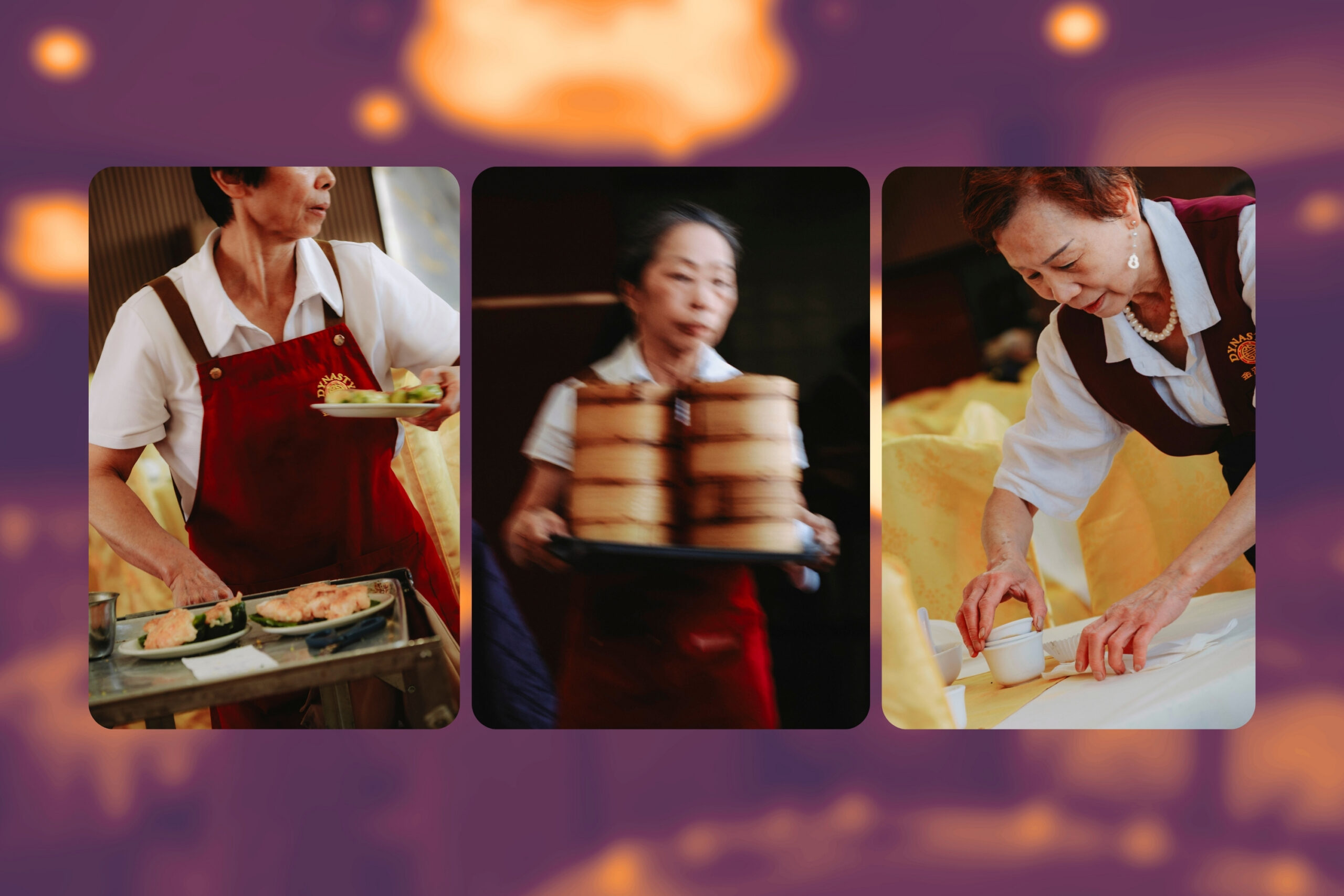
With interpretation by Wai-Ling Lennon and photography by Jordon Hon
“Haa gau, siu maai,” “fung zaau,” “pai gwat”![1] Growing up in Edmonton, my most consistent community exposure to my maternal heritage language, Cantonese, was at dim sum[2] restaurants – Marco Polo, Empress Table, Jumbo, Urban China, Dynasty Century Palace. The hiss of hot water, people talking over each other, and the calls of the aunties shouting out their wares as they pushed carts piled with steamed, baked, and deep-fried delicacies through a sea of tables. The clamour offered the environment for me to soak up vocabulary, intonation, attitude. And the dim sum aunties were my language teachers.
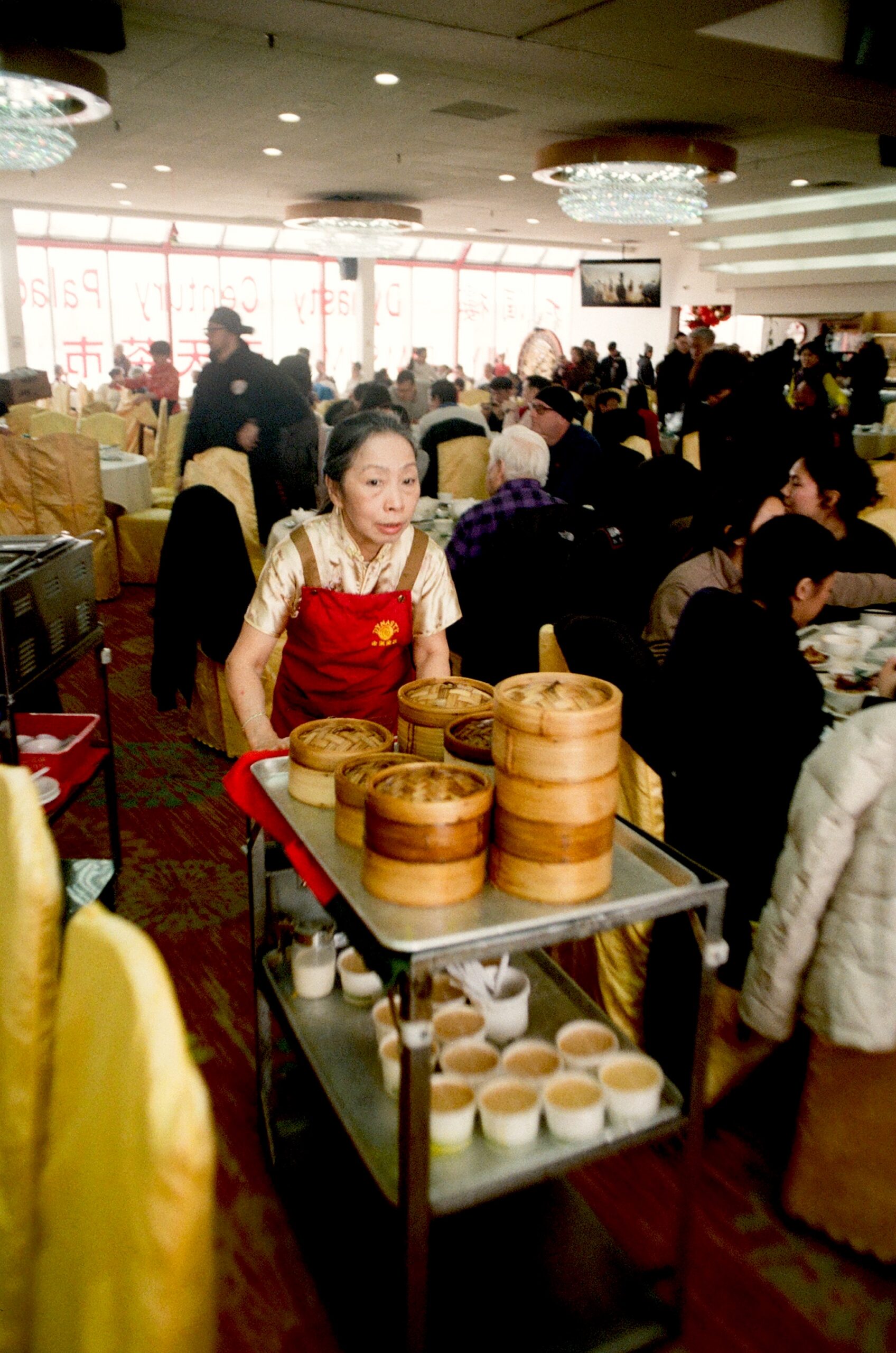
This story is a tribute to the women who serve dim sum at Dynasty Century Palace. I interviewed a group of them after a busy Sunday service, with help from my mother Wai-Ling Lennon as interpreter, and my friend Jordon Hon as photographer.
We arrive at 1pm, to introduce ourselves and order dim sum. It takes some teasing, and some conversations about grandbabies, but several staff agree to speak with us.
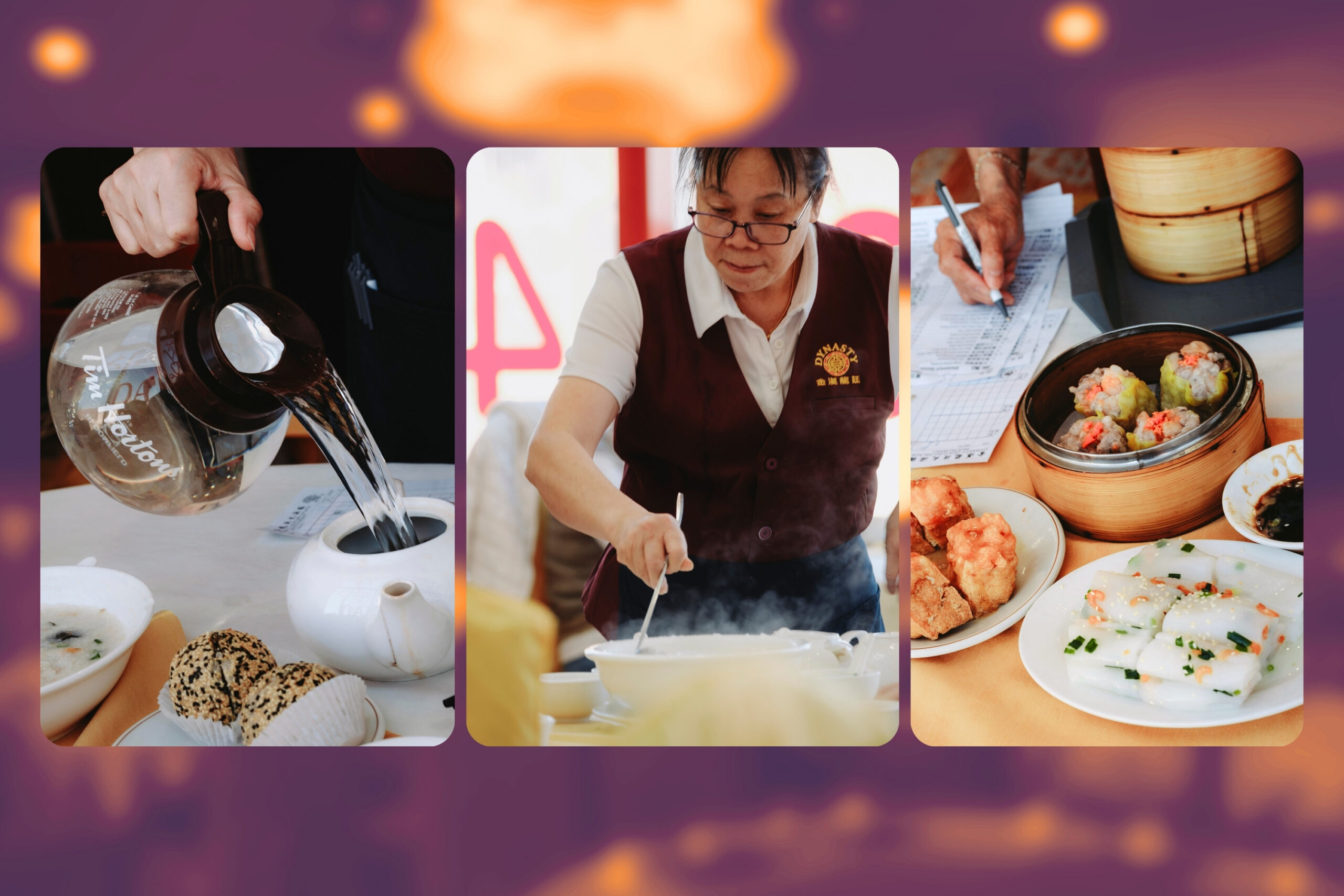
How long have you worked here?
Ho loi! A long time!
Don’t you want to retire?
As long as the boss keeps me, I’ll keep working!
What do you enjoy about your job?
Ho hoi sum! Very happy! It’s comfortable here.
I love to see the customers. The more customers, the more energy you feel.
Our boss (lou ban) is really good.
My colleagues (tong see). They’re like family.
How have things changed?
There are more Westerners[3] (“Do de sai yun”). Less oldtimers (lo wa kew, old overseas Chinese)
What’s the secret to selling dim sum? How do you communicate with customers if you don’t speak the same language?
It’s very important to introduce what you are selling. “La goa hoa sik” (this one is delicious). “Lai see ha!” (try it, you’ll like it).
Customers see the food, they like it, they want more! Our kitchen people, our chef, are very good!
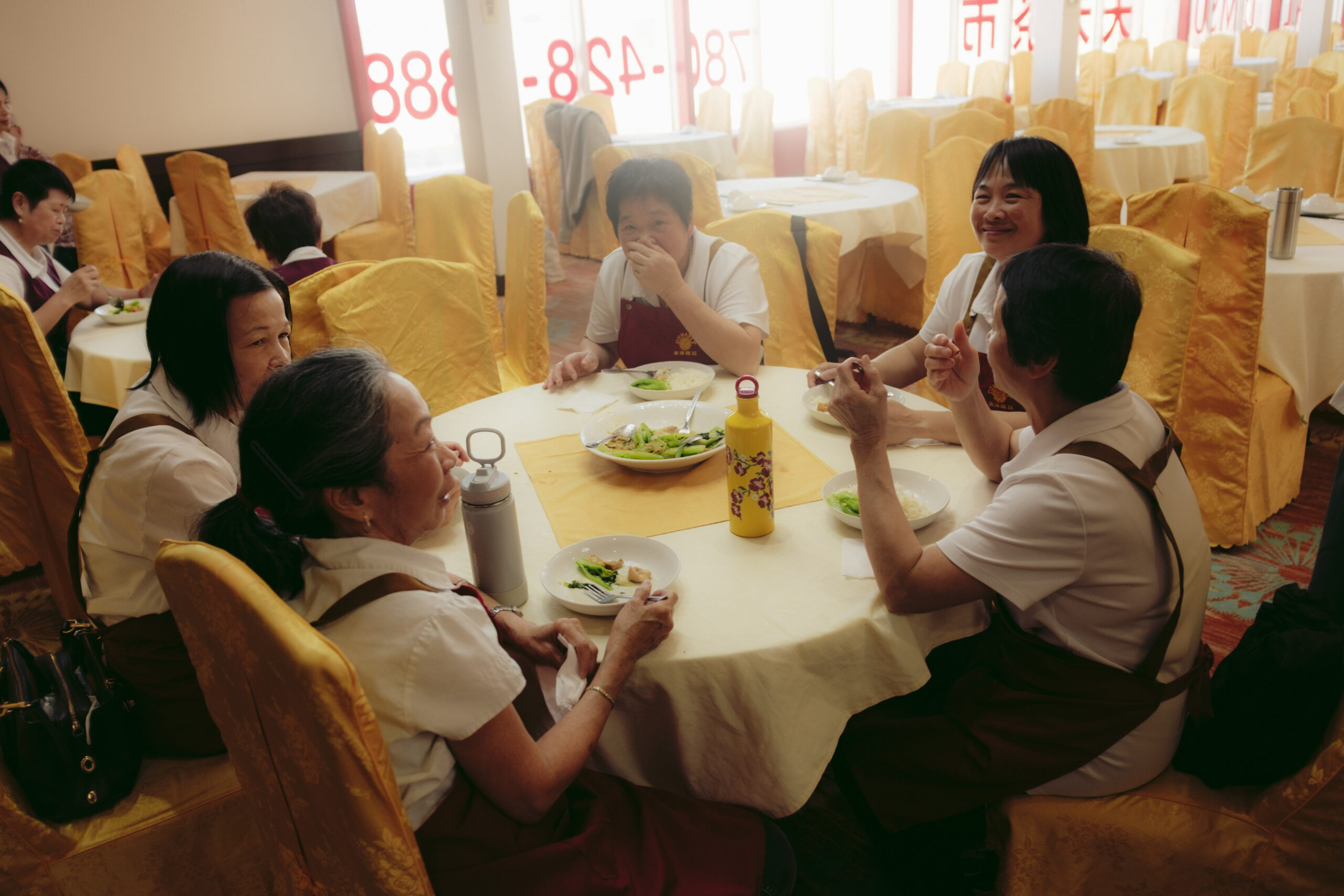
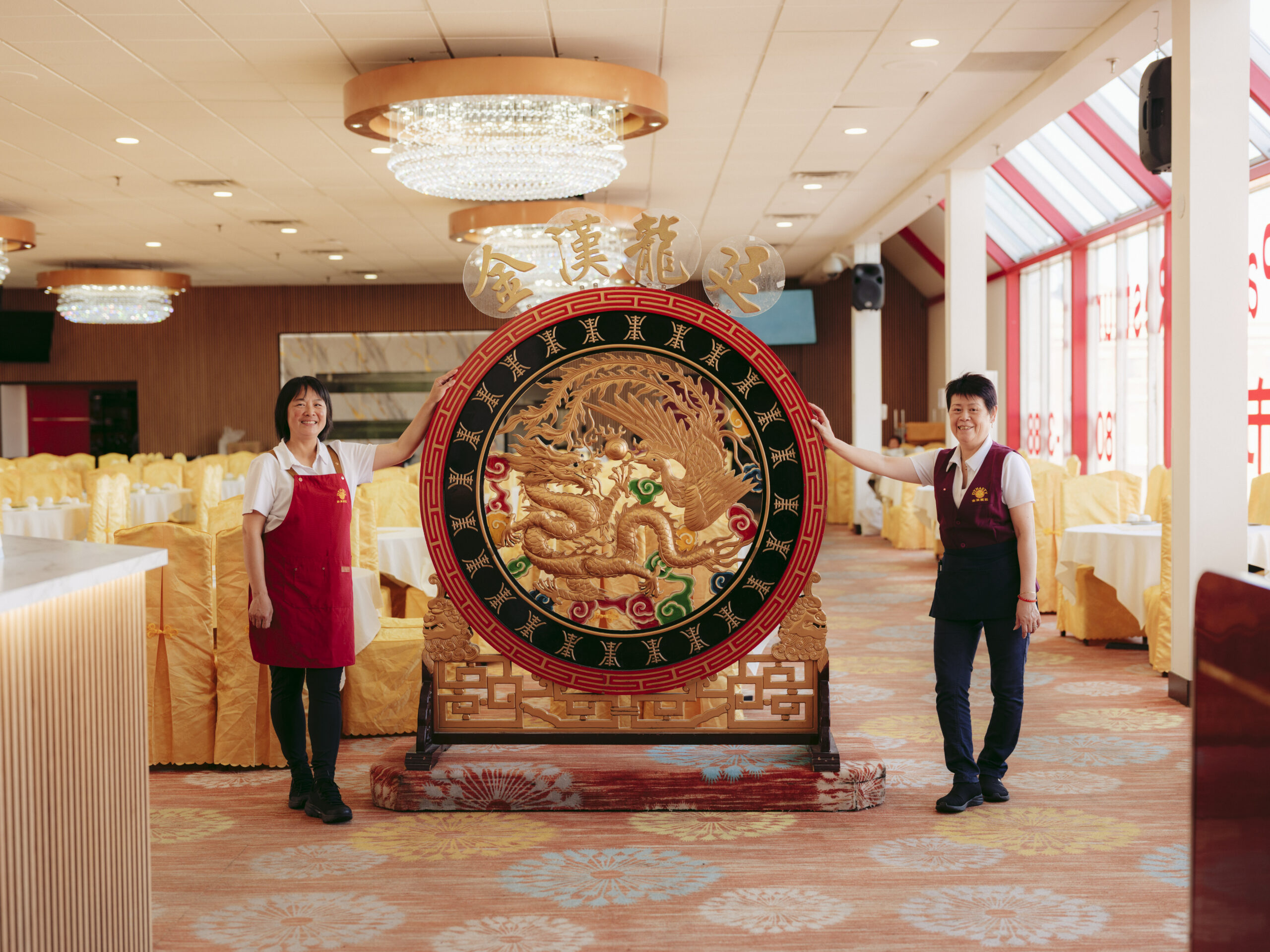
At 3 pm, after feeding a banquet-hall full of customers, they clear dishes, change tablecloths, vacuum, and reset the tables for dinner service. Then, they gather around a meal of rice, veggies and tofu. They wave us over – now they are happy to take questions. When I ask the same question to more than one auntie they say, no need to talk to each of us, we all have the same story. We ask how we should address them, they discuss amongst themselves – they don’t want to be named, but it’s ok to use their photographs. Don’t call them aunties, they are not old! How about sisters (jie jie)? Yes, they like that.
The Dim Sum Sisters wear crisp white shirts, black slacks, and good runners. They sport tidy bobs and pixie cuts. There are two main roles. Servers pour tea, re-set tables, and deliver bills. Cart ladies wheel around dim sum carts, calling out the dishes they have on offer, stamping dim sum tickets, and encouraging customers to try new things. Their movements are swift, masterful, bird-like. They pour sauce, cut food with kitchen scissors, remove bamboo steamer lids to entice customers with the barbecue pork buns inside. Far more than performing physical labour, as Jordon sees it, “they are curating the atmosphere.”
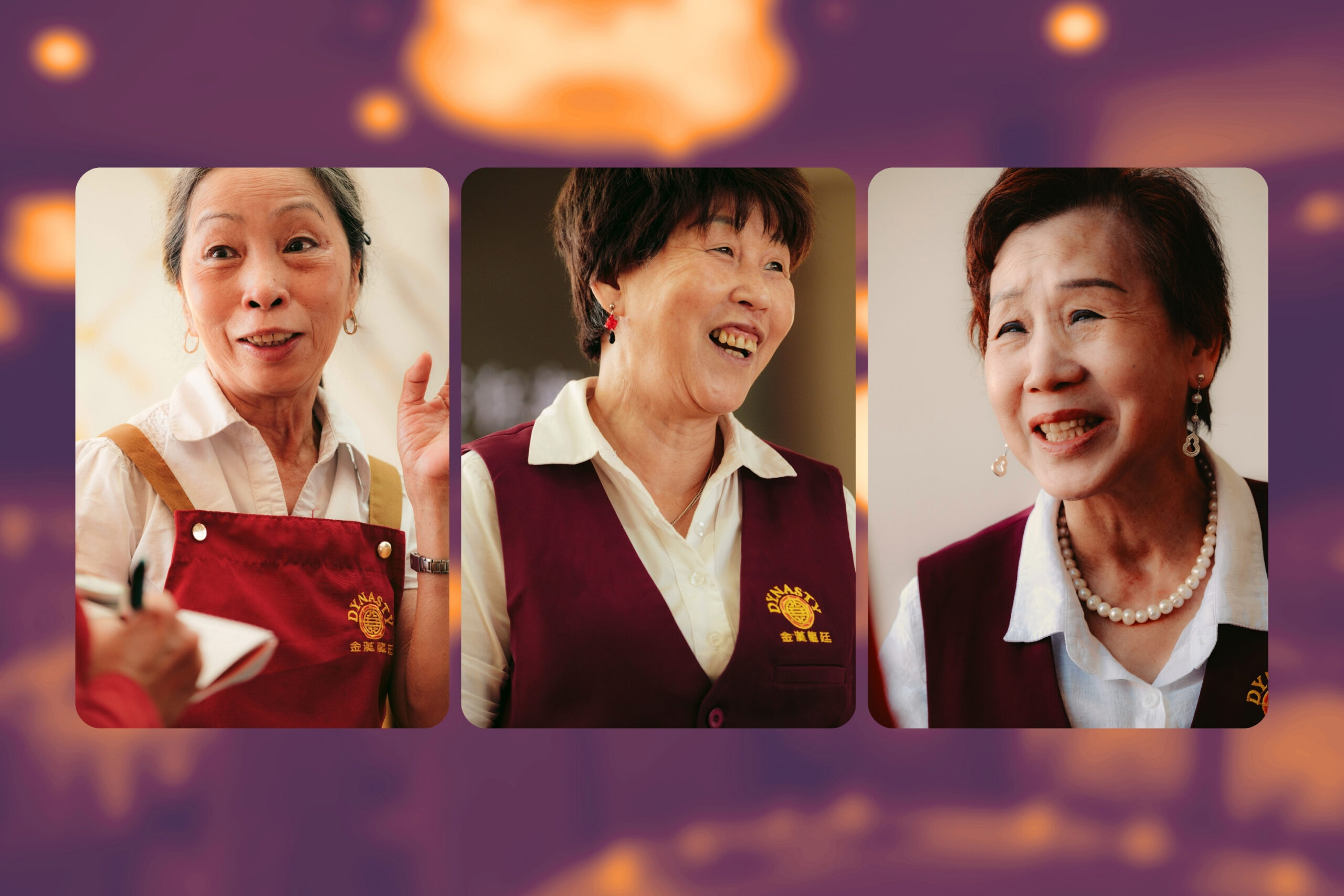
They come from Guangzhou, from Taishan, from Vietnam. They are widows, proud grandmothers. Some are near retirement, some support adult children with learning disabilities. Many have worked here for decades. One has worked here since 1988, offering her consistent presence through multiple ownership and business name changes. The newest has worked here five years. They have worked at other keystone food establishments – packing vegetables at Lucky 97, as servers at Pearl City,[4] or at Marco Polo (the previous iteration of Dynasty Century Palace). They care about doing their job well and bringing in income to support themselves and their families.
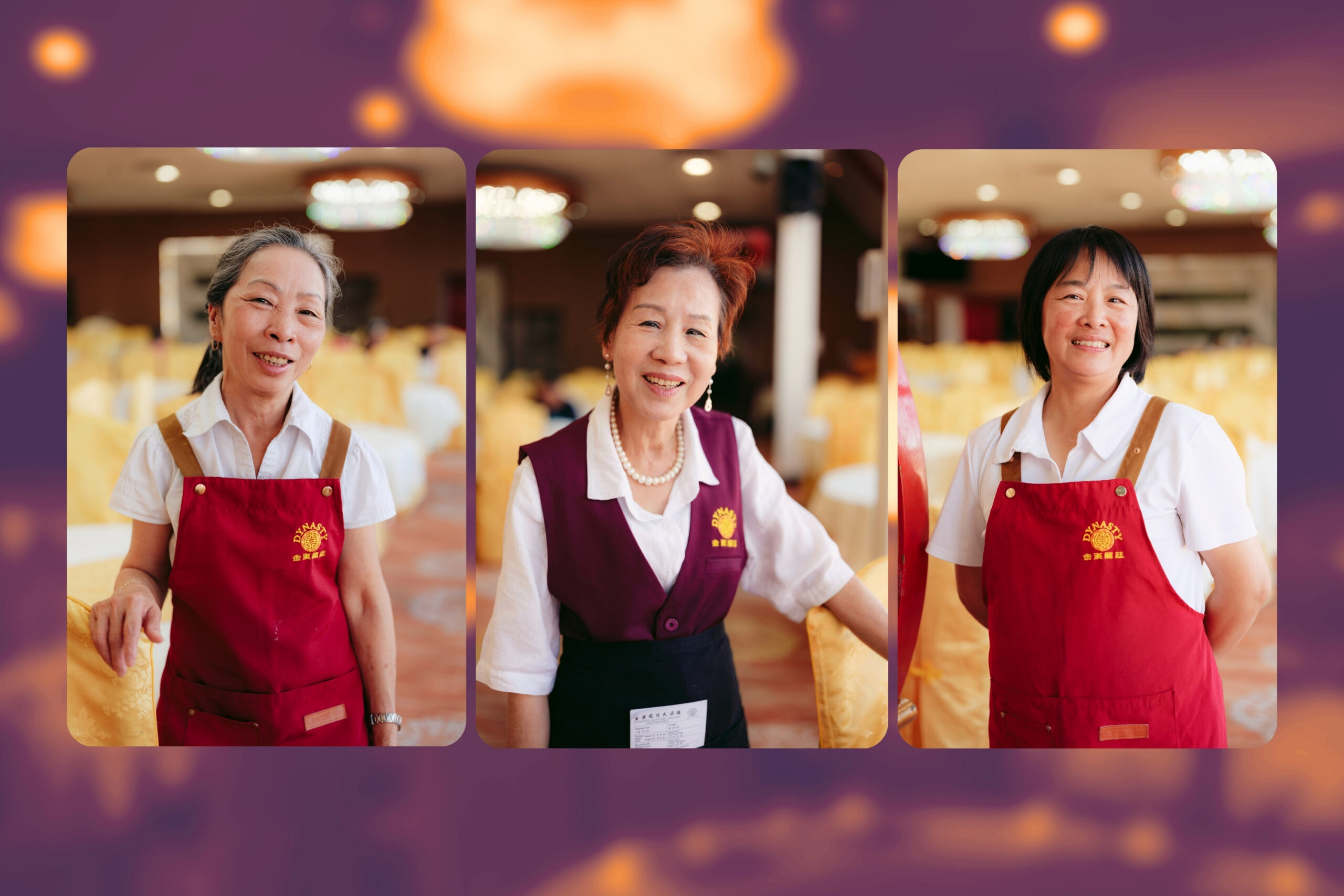
Cantonese is the common language of their workplace. But they also speak Toisanese, Vietnamese, some Mandarin, and modestly claim to only speak a little English (“Ying mun, ho siu”). Toisanese is a key language at dim sum, both for staff and patrons. Donna Seto, author of Chinatown Vancouver: An Illustrated History, recently visited Dynasty Century Palace on a trip to Edmonton and observed, “It was a real throwback, just walking into a large banquet hall and hearing all the Toisan. We don’t get much of that anymore in Vancouver – Toisan, big banquet halls are becoming more and more rare, as are dim sum carts.” Dim sum has not always been served by cart, and it may not continue to be served in this way for much longer.[5] The cart style of service is vanishing from banquet halls around the world, from Hong Kong to Vancouver.[6]
Dynasty Century Palace is a second-floor restaurant located in Pacific Mall, in Chinatown. The first restaurant on site was Marco Polo, which opened its doors in 1988. Dim sum became popular in Edmonton by the 80s and 90s,[7] likely due to the arrival of new waves of Hong Kong Chinese in Canada.[8] Through several owners and name changes, the restaurant has maintained its traditional dim sum service. Nowadays the restaurant only offers cart service on weekends, with 5-6 Dim Sum Sisters pushing carts. They used to have 12, but business is quieter in Chinatown these days. Still, the banquet hall continues to function as a community space – hosting birthdays, weddings, funerals, holidays, community meetings, fundraisers – the whole “circle of life” as owner Tom Ly puts it.
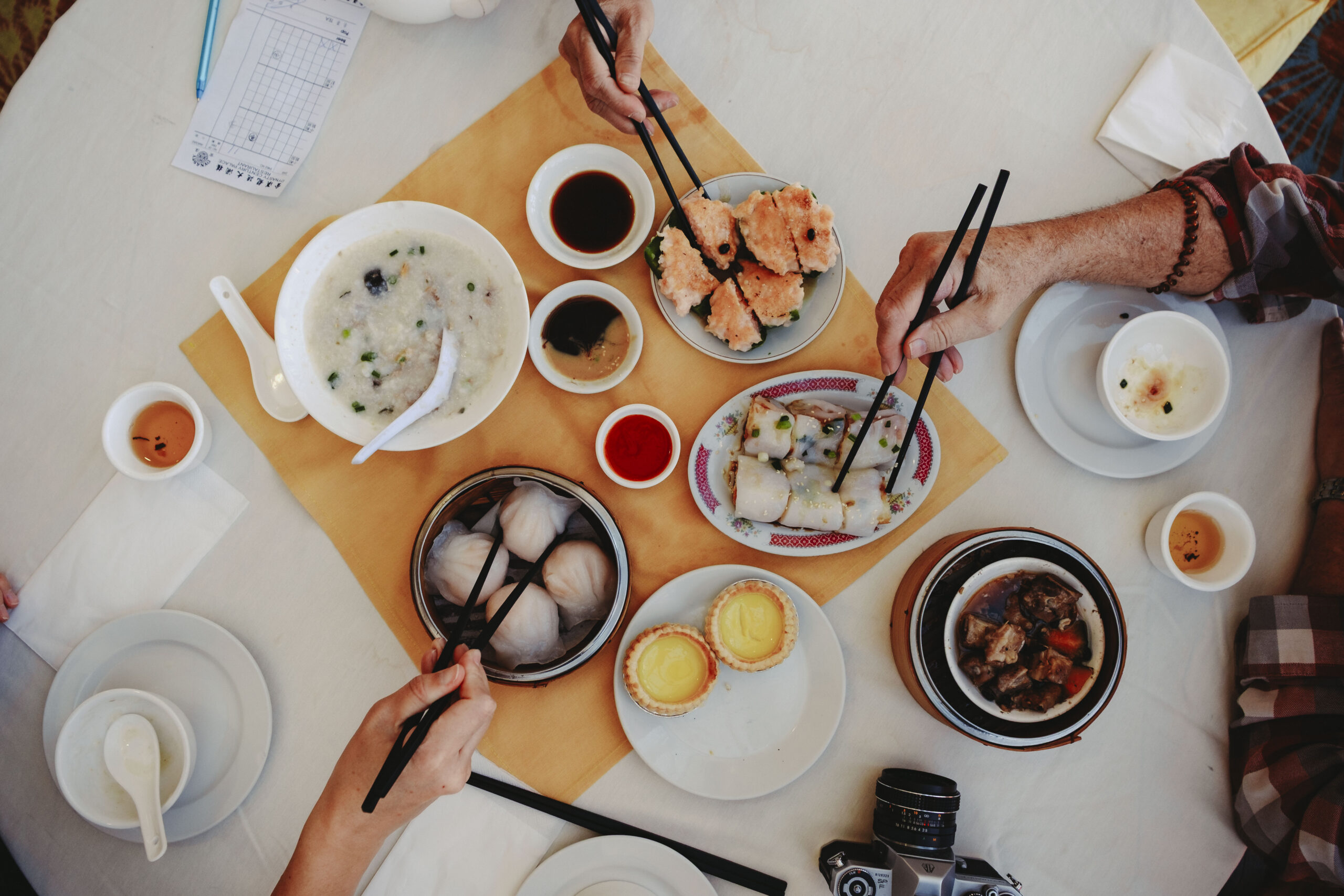
All of the dim sum at Dynasty Century Palace is made in-house. Top-selling dishes are siu mai (pork and mushroom dumplings), haa gaau (shrimp dumplings), fung zaau (chicken feet), and lo mai gai (sticky rice in lotus life). “Fung zaau,” which literally translates as “phoenix claws,” is a classic dish. Chicken feet are deep fried, then braised in a mixture of star anise, ginger, garlic, oyster sauce, and more. Discerning customers will judge a restaurant on the flavourfulness of the sauce.
People judge dim sum on its price, size, and consistency. But we also come back for the atmosphere. A friend tells me she was served dim sum by robots at Good Buddy North, and how awkward she felt receiving food from a robot. Dim sum is at its heart a social activity, and a digital menu or a robot can’t deliver the human warmth required. I wonder what will happen when the Dim Sum Sisters retire. Where will my kids get to practice their Cantonese as a functional, public language? More than servers, they are ambassadors for culture, language teachers, and community connectors. When they wheel carts stacked with bamboo steamers through the banquet room on weekend mornings, they are everybody’s aunties. They push food at us, encourage us to try this one, it’s the best. Eat more! They exclaim over our babies. They tell us we are “ho lek,” very smart! For speaking English, for studying, for getting a job. They tease us. They tell us we’re beautiful, “Wah, lang lui!” (wow, beautiful girl!), “Lang zai!” (beautiful boy!) – no matter whether we are 4 or 40 years old.
So much of our intangible cultural heritage is delivered to us by their hard-working hands and brusque affection, and I am grateful.
Footnotes
[1] These are some of my favourite dim sum dishes.
[2] Dim sum 點心 (the Cantonese pronunciation) literally translates as “touch the heart”. In Hong Kong, it is more commonly called “yum cha,” meaning “drink tea,” because of the pots of tea you drink alongside your meal to aid digestion. Hong Kong Chef, ArChan Chan writes, “Yum cha has a long history and is believed to have first appeared in China during the Tang Dynasty (618-907 CE),” in ArChan Chan, A Day in Hong Kong: A Cantonese Cookbook, (Smith Street Books, Australia), 2024, 36. Dim sum is widely recognized as Hong Kong and Cantonese cuisine, but many of the dishes eaten at dim sum originated in Guangdong or other parts of southern China, with roots in Teochew (or Chiu Chow), Hakka, Hokkien, and Cantonese culinary traditions, and variations around the world as Chinese diaspora blended their ingredients and recipes with regional ingredients.
[3] “Sai yun” literally means “western people” in Cantonese, a common way to refer to people of European descent.
[4] Pearl City is the first place my mom remembers having dim sum in Edmonton, in the 1980s. It was located in the basement of a building on 97 street, near Canada Place. Items were 99 cents. My parents held their wedding banquet there in 1983.
[5] “Yum cha has undergone a significant evolution in the past few decades,” chef ArChan Chan explains in A Day in Hong Kong, 36. “From staff carrying pre-cooked dim sum in big baskets in the 1960s, to the use of dim sum push-carts or trolleys (for more choice and quantity in one go) and the eventual adoption of a paper-based ordering system allowing for made-to-order demand and the reduction of food wastage now used in most dim sum restaurants.”
[6] “Hong Kong’s dim sum trolleys are a tradition worth preserving,” South China Morning Post, July 14, 2025, accessed November 2, 2026, https://www.scmp.com/opinion/comment/article/3317890/hong-kongs-dim-sum-trolleys-are-tradition-worth-preserving.
[7] I want to find out where and when dim sum first arrived in Edmonton. I do an informal poll of friends and members of the Our Chinatown Edmonton Facebook Group, asking if they remember where they first had dim sum in Edmonton. The comments flood in. Wonderland Seafood (1985). China Garden and Pearl City were 1980s mainstays. Marco Polo. Bamboo Palace. Jumbo in the 1970s. Moon’s Cafe. My Lai Gardens in the 1970s. Furama (which became Mirama). Golden Rice Bowl, New Tan Tan, Urban China, Cha for Tea Palace. The most commonly mentioned is Pearl City. A dim sum ticket in the Bruce Peel Archives from My Lai Garden (located at 7918 Jasper Avenue) dates back to the 1970s and seems to be the earliest documented ephemera in the archives that mentions dim sum (Caroline Lieffers and Jason C. Wong. “Pig’s Liver Rice Crepes: A 1970s Edmonton Dim Sum Ticket”. Cuizine 5, no. 1, 2014, https://doi.org/10.7202/1024277ar). Moon’s Café is also named as the first restaurant in Edmonton to serve dim sum in a 1989 Edmonton Sun article that profiles the Mah Moon family. (Anne Alexander, [Title unknown], Edmonton Sun, October 15, 1989). A 1994 Edmonton Journal Article, “Stroll through Chinatown” by Judy Schultz mentions dim sum, “a morning shopping excursion for groceries and a leisurely snoop around Chinatown, followed by dim sum in one of the restaurants, then home with groceries to cook for dinner,” (Judy Schultz. “Stroll through Chinatown,” Edmonton Journal, September 25, 1994).
[8] “The 1980s and 1990s introduced Canada to a new kind of Chinese,” journalist Ann Hui writes in her book Chop Suey Nation: “Unlike the previous waves of mainly poor, rural Chinese, now there were hundreds of thousands of middle-class and wealthy Hong Kongers fleeing to Vancouver and Toronto ahead of the 1997 China handover. This group included some of Hong Kong’s most highly skilled, highly trained Cantonese chefs.” Ann Hui, Chop Suey Nation (Douglas & McIntyre, 2019), 46.
Additional Sources
Culinaria: A Taste of Food History on the Prairies, U of A, Bruce Peel Collection. Chinese Restaurant Ephemera. https://omeka.library.ualberta.ca/exhibits/show/culinaria/item/1568
Fung, Nathan and Chris Chang-Yen Phillips. “Episode 43 – Mirama Memories,” Let’s Find Out, July 8, 2020, https://letsfindoutpodcast.com/2020/07/08/episode-43-mirama-memories/
Erik Floren, “Chinatown’s charms: Going to the city’s most colourful neighbourhood is almost like leaving town”. Edmonton Sun, June 14, 2003.