History of West Ritchie

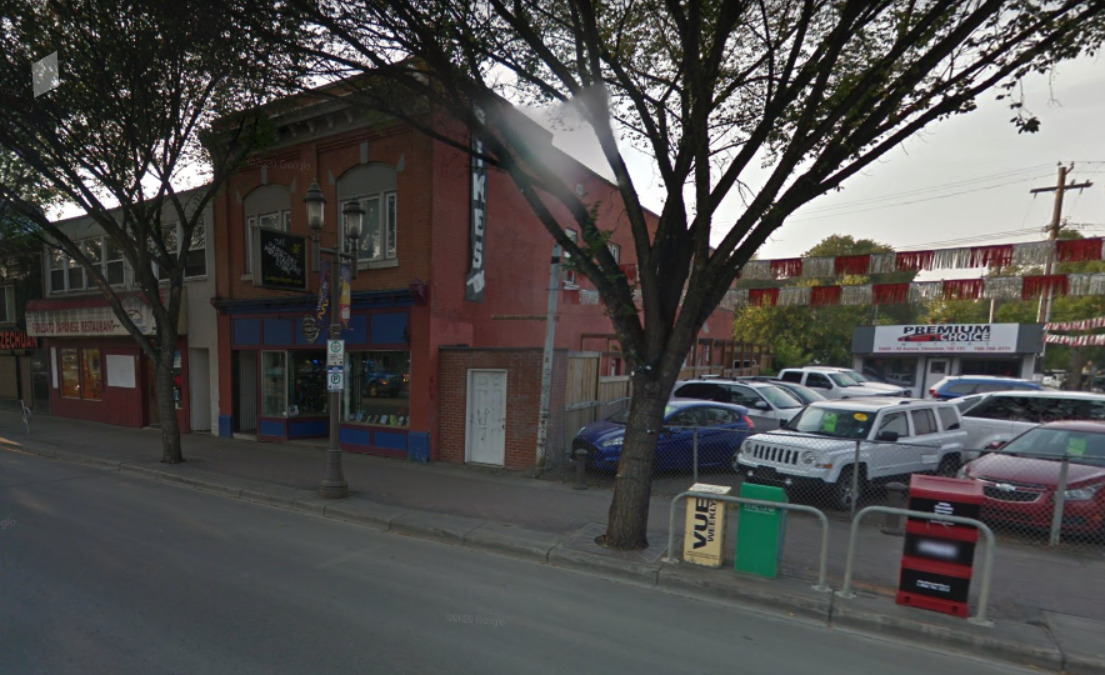
At the center of West Ritchie is 81st Avenue (between 102nd and 100th Street), a commercial street that feels far removed from the routine bustle and three-to-four storey brick structures on neighbouring Whyte Avenue. At one end of the avenue is an empty lot (at the corner of 102nd Street), being transformed into a 4-story residential and retail structure of modern elegance. The transformation of the space represents an Edmonton that is welcoming more people and new homes into our oldest communities. On the other end (at the corner of 100th Street), on the north side of 81st Avenue, a German church tower soars up above the other objects in sight, providing a landmark speaking to the history of settlement in the area.

In the fragments of space between these two points, small shops with clean utilitarian facades harmoniously, but not intentionally, form what appears to be the main street from the American West in the mid-to-late nineteenth century. Many of the local business owners who operate inside these square-topped, billboard-like buildings cater to the artistic and unconventional tastes of Edmontonians in the neighbourhood. The facades of their shops form a continuous line that once drew a neat path to the Strathcona Canadian Pacific Railway Station.

/><figcaption><em>81 Avenue looking west from 101 Street. In the background, centre, a narrow rectangular building now blocks the view to Strathcona C.P.R Station where there once was an uninterrupted sightline (as visible in the bottom image.) Image captured by the author using Google Earth street view. </em></figcaption></figure>
<figure><img src=page 40 of the Strathcona Redevelopment Plan by the City of Edmonton.
/><figcaption><em>The C.P.R Strathcona Station, now MKT Fresh Food & Beer Market. The station is marked with a blue star on the Strathcona Redevelopment Plan map above. Image Courtesy of the ECAMP Team, September 2020. </em></figcaption></figure>
<p><strong>German-speaking C</strong><strong>ommunities</strong> </p>
<p>While mass settlements of German-speaking people started with the arrival of the rail line between Edmonton and Calgary opening in August 1891, the reason behind who arrived is prefaced by earlier settlement patterns. And these patterns went on to influence particular developments in West Ritchie. As early as 1885, a small community of German people were recorded in the Canadian census stationed in houses on the north side of the river.  </p>
<p>As testimony travelled from Canada back to the “homeland” and south Edmonton formed an early manufacturing industry that was complementary to the agricultural activities around the rail line station and the greater region, German-speaking settlements spread across the land between Edmonton, Wetaskiwin, and Camrose. Excerpts from newspaper articles and travel journals document the surprise of many German-speaking newcomers to discover the distance of their land claims from the station they arrived at. And indeed, as feelings of now being far removed from the “homeland” set in, the keeping of the German language remained vital to alleviate new anxieties and to share stories of the past. In the region, thirteen German-speaking communities had formed by the start of the twentieth century.  </p>
<p>While the German language had the quality of connecting families across the region together, German-speaking communities were divided along religious lines. The Moravians, a protestant denomination that emigrated from Volhynia (what is now part of the Ukraine, at the time Russia) formed a community called Bruderheim outside of Edmonton. By embarking on a long journey to south Edmonton, the Moravian’s had an opportunity to enjoy religious liberty and to hold land, a privilege not enjoyed in Russia. These motivations, however, quickly vanished upon first setting foot on Bruderheim. The isolated feeling and the heavily timbered nature of the land drove several families to return to South Edmonton. </p>
<figure><img src=
Immigration Hall was located on 80th Avenue and 101st Street. Today, it is the site of an apartment building. Photographer: McDermid Studio, Edmonton, Alberta, September 1919. Photo courtesy of the Glenbow Library and Archives, University of Calgary, NC-6-4659.
  •  data-id=
    Kuntz & Co, a farm implements shop, was located directly to the north if Immigration Hall on 81st Avenue. 1913. Photo courtesy of the Glenbow Library and Archives, University of Calgary, NA-1328-1178.
  • As more and more families settled in West Ritchie, the social infrastructure necessary to bring people together to a common space had surfaced. In 1902, a block north of Immigration Hall, on 81st Avenue, the Trinity Evangelical Lutheran Church was founded as a wood frame structure. It was replaced in 1914 by the red brick building seen today. Local businesses, run by and sometimes catering to German-speaking people, only strengthened this distinct social fabric.

    People of West Ritchie

    At the age of five (1894), Adolf Minchau travelled from Russia to south Edmonton with his uncle and aunt, August and Carolina. In the years that followed, Adolf assisted his relatives on the family farm, learned the millwright’s trade at John Walter’s sawmill, and became an apprentice to a local blacksmith. At twenty-two, Adolf opened his first blacksmith shop at 7711-99 Street in 1911 that soon was replaced with a new expanded facility built at 8108-101 Street in 1920.
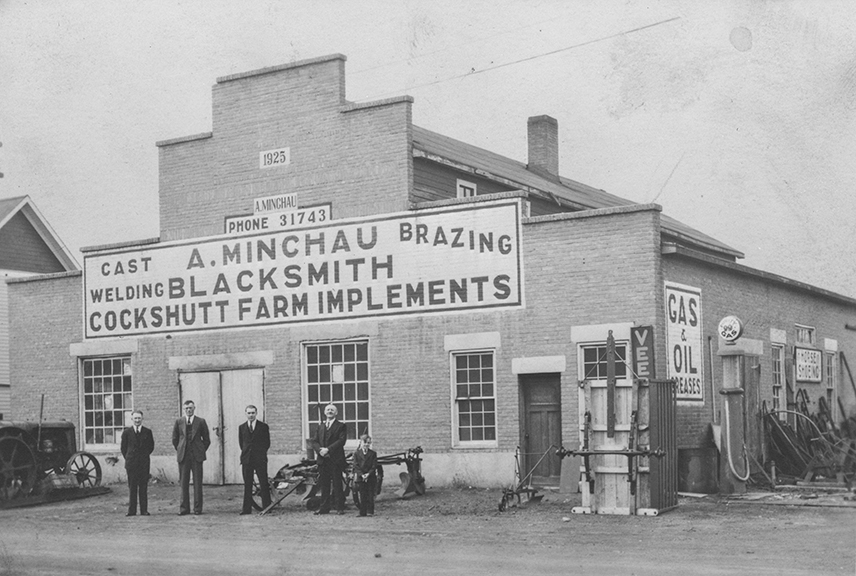
    Left: Moreau & Sons Grocers, located at 10008 – 82 Avenue NW. The wholesale grocery store was run by David Moreau as early as 1912, with the assistance of his two sons, Louis and Joseph. Between 1912-1962, ownership switched often, and the building had been used as a deli, electronic store, and bakery. As of 1939, the building has been referred to as “Whyte Avenue Block.” Photo courtesy of the City of Edmonton Archives, EB-26-459. Right: The same building in present day. Image captured by the ECAMP Team using Google Maps, November 2020.